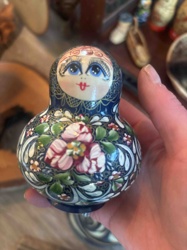
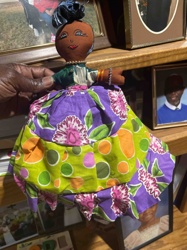
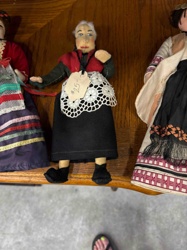
Purchased in Russia in the 1990’s but I don’t know if that’s when it was made
These notes were written by the person who submitted this item. Appraiser.AI has not verified them, and the AI's identification and estimate may rely on them.
AI Estimated Value
Not an official valuation
$75 - $125
AI estimate as of November 6, 2025 · verify with a professional before acting
AI-Generated · Verify before acting
Everything on this page is generated by AI for informational purposes only. AI can make mistakes — the AI may misidentify items or misattribute them (artist, maker, brand, designer, origin, era). This is not an official valuation and should not be used for insurance, sale, tax, estate, legal, or lending purposes — or any decision requiring a certified appraisal. It is not an authoritative claim about any person, brand, or rights holder — do not share or rely on it as a factual statement about a third party. Always consult qualified professionals before making financial decisions.
This analysis also relies on unverified notes provided by the user, which may be incomplete or inaccurate and could affect the result.
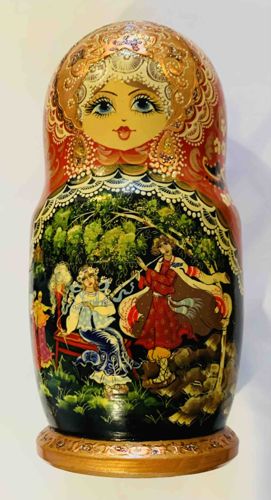
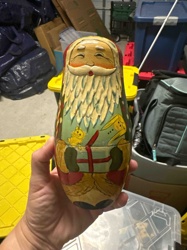
This is a single hand-painted Russian Matryoshka doll, likely the outermost doll of a nested set, characterized by its traditional shape and vibrant decorative elements. Made of wood, it features a smooth lacquered finish that gives it a glossy appearance. The doll is predominantly painted in rich, warm colors, including a striking red on the upper body and a deep green and black on the lower section, delineating two distinct pictorial scenes. The 'face' of the doll, located on the upper red section, is intricately painted with blue eyes, red lips, and delicate eyelashes, framed by an elaborate golden head covering or kokoshnik adorned with white dotted patterns and floral motifs, representing fine lace or embroidery. Below the face, a white scalloped pattern with gold outlines suggests a collar or neckline. The central and lower body of the doll depicts a detailed narrative scene, possibly from Russian folklore or a pastoral setting. One figure, possibly male, is shown in motion, playing a long wind instrument (flute/pipe), dressed in a red tunic, brown cloak, and light-colored boots. Another figure, seemingly a woman, is seated on a red bench, dressed in a blue and white garment, with an elaborate headdress, possibly a kokoshnik. Foliage in shades of green and brown fills the background, creating a forest or garden setting. The craftsmanship appears to be of good quality, with fine brushwork evident in the facial features and the intricate details of the clothing and background elements. The base of the doll is a separate, lighter wooden piece with carved or painted decorative banding in a metallic gold or bronze color, suggesting it is designed to be removed to reveal smaller nested dolls inside. While the current image only shows one doll, the nature of matryoshka dolls implies it is part of a larger set. There are no immediately visible condition issues such as chips, cracks, or significant paint loss, and the lacquer appears to be intact, lending a well-preserved appearance. Purchased in Russia in the 1990s, the doll could have been manufactured around that period or be an earlier piece from the late 20th century.
AI Appraisal Report
Based on my visual examination of the provided image, this hand-painted Russian Matryoshka doll appears to be in excellent condition. The lacquered finish is intact, and there are no visible chips, cracks, or significant paint loss. The intricate brushwork, vibrant colors, and detailed narrative scene suggest a piece of good quality craftsmanship. Authenticity, based solely on visual inspection, points towards a genuine Russian-made matryoshka doll, consistent with styles produced in the late 20th century.
Market conditions for folk art matryoshka dolls are relatively stable. While mass-produced sets can be inexpensive, individually hand-painted, higher-quality dolls like this one command more value. Comparables for well-preserved, single-outermost dolls from the 1990s or earlier often fall within this range, particularly those depicting detailed scenes rather than simple floral motifs. Demand for traditional Russian folk art remains consistent among collectors and those appreciating cultural handicrafts. Rarity is not a significant factor here, as many such dolls were produced during that period.
Factors impacting value positively include the doll's apparent excellent condition and the detailed artistic merit of the painting. The fact it's likely the outermost doll of a set, generally the most detailed and largest, also adds to its individual value.
It is crucial to note the limitations of authenticity verification from images alone. While visual cues strongly suggest authenticity, an in-person examination would allow me to assess the wood quality, paint texture, and internal construction for a more definitive confirmation. Provenance documentation, such as original purchase receipts or artist signatures (which are not visible here), would further solidify its history and authenticity. Scientific testing, while usually unnecessary for items of this nature unless forgery is suspected, could analyze paint composition if absolute certainty were required.