AI estimate as of August 21, 2025 · verify with a professional before acting
AI-Generated · Verify before acting
Everything on this page is generated by AI for informational purposes only. AI can make mistakes — the AI may misidentify items or misattribute them (artist, maker, brand, designer, origin, era). This is not an official valuation and should not be used for insurance, sale, tax, estate, legal, or lending purposes — or any decision requiring a certified appraisal. It is not an authoritative claim about any person, brand, or rights holder — do not share or rely on it as a factual statement about a third party. Always consult qualified professionals before making financial decisions.
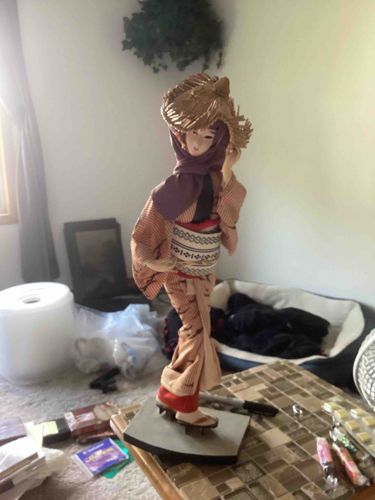
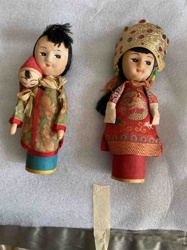
This item is a decorative doll, likely originating from Japan, depicting a female figure in traditional attire. The doll stands on a rectangular, dark-colored base, possibly made of wood or a composite material, with a beveled front edge. Its overall height appears to be approximately 1.5 to 2 feet, given its proportion to the surrounding furniture. The figure is elaborately dressed in a multi-layered kimono-style garment. The outermost layer is a muted reddish-orange or light brown fabric with subtle vertical striped patterns, possibly indicative of a simple weave. A distinct obi (sash) circles the waist, featuring a geometric pattern of black and white or cream elements. Below the obi, the patterned fabric appears again. A dark purplish-brown scarf or hood covers the doll's hair and neck, framing a finely detailed porcelain or composite face. The facial features are delicate, with painted eyes, eyebrows, and lips, imparting a serene expression. A large, intricately woven straw hat rests on her head, partially obscuring the scarf and contributing to a traditional, possibly rural, Japanese aesthetic. Her right hand is raised, seemingly holding or adjusting the hat, while her left hand is obscured but likely holding part of her clothing. The visible foot wears a red footwear, possibly a zori or geta, and white socks (tabi). The doll's construction appears to be a mixed media, utilizing fabric for clothing, a rigid material for the head and hands (though hands are not clearly visible), and potentially a wire armature or similar internal support to maintain its pose. The fabric drapes naturally, suggesting skill in tailoring. There are no obvious signs of significant damage like tears or major stains on the fabric, and the overall condition appears good, with minor dust potentially accumulated on the surfaces. The craftsmanship suggests it is a collectible or an ornamental piece, likely from the mid to late 20th century, designed for display.
AI Appraisal Report
Based on my visual examination of the provided image, this Japanese decorative doll, likely depicting a geisha or folk art figure, appears to be in good overall condition. The fabric elements show no obvious tears or significant stains, and the colors seem well-preserved. The porcelain or composite face is finely detailed and free from apparent chips or cracks. The intricate straw hat and multi-layered kimono suggest a commendable level of craftsmanship.
From the image alone, I assess its authenticity as a collectible Japanese decorative doll from the mid-to-late 20th century, consistent with similar items found in the folk art or souvenir market. However, certain limitations exist in definitive authentication without physical inspection. I cannot verify the material composition of the face and hands (e.g., porcelain, bisque, composite) or the internal armature. Provenance documentation (e.g., origin, artist, purchase records) would further solidify authenticity and historical context. Without in-person examination, it is impossible to detect minor unseen damages, repairs, or the quality of internal construction which could impact value.
Market conditions for such decorative dolls are stable but not rapidly appreciating. Comparables include other finely crafted Japanese dolls from the Showa era, often found in specialty antique stores or online marketplaces. Demand is generally from collectors of Asian art, decorative arts, or those seeking unique accent pieces. While not extremely rare, the doll's good condition and detailed craftsmanship make it a desirable ornamental piece. Factors impacting value positively include its apparent condition, detailed attire, and serene expression. Negative factors, if any, would be its likely mass-produced nature (though high quality) and the lack of specific artist attribution or historical significance without additional information. A full authentication would require examining material composition, seeking artist signatures/marks, and verifying provenance.