AI Appraisal Estimate

AI-generated estimates · not official valuations

From the user

What was submitted

Photo and notes provided by the user — not generated by AI

Submitted item photo
Submitted photo · June 1, 2026

User's notes

No additional notes provided.

AI analysis below

AI appraisal

AI analysis & estimate

AI-Generated · Verify before acting

Everything below is generated by AI for informational purposes only. AI can make mistakes — the AI may misidentify items or misattribute them (artist, maker, brand, designer, origin, era). This is not an official valuation and should not be used for insurance, sale, tax, estate, legal, or lending purposes — or any decision requiring a certified appraisal. It is not an authoritative claim about any person, brand, or rights holder — do not share or rely on it as a factual statement about a third party. Always consult qualified professionals before making financial decisions.

Read the full disclaimer

AI Identification

·Not independently authenticated·Verify before acting

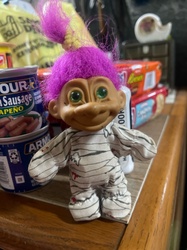
Vintage Handmade Folk Art Cloth Doll

Toys and Collectibles / Dolls

AI Estimated Value

·Not an official valuation·Verify before acting

$45-75

As of June 1, 2026

AI Item Analysis

·AI can make mistakes·Verify before acting
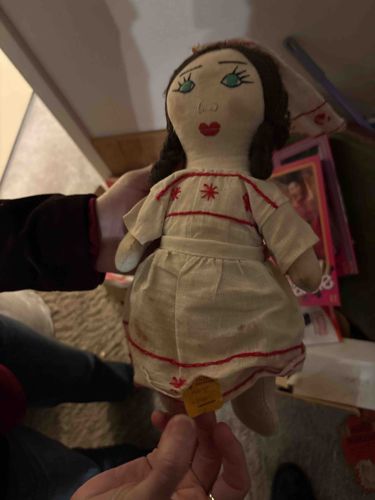
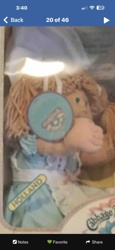
This is a vintage handmade cloth doll, likely originating from the mid-20th century. The doll features a soft-sculpted face with primitive hand-stitched detailing, including prominent green-thread eyes, arched eyebrows, and a red-thread heart-shaped mouth. Its hair is constructed from dark brown yarn, styled into two long braids. The doll is dressed in a traditional or folk-style cream-colored linen or cotton dress, which is decorated with red embroidered asterisks and horizontal banding along the hem, sleeves, and neckline. A matching headscarf with similar red embroidery is pinned to the head. The construction displays characteristics of home-made or cottage-industry craftsmanship, utilizing basic sewing machine work for the structural seams and hand-embroidery for the facial features and garment accents. Regarding condition, the fabric shows significant age-related yellowing and localized staining on the skirt. There is visible wear to the yarn hair and the overall stuffing appears settled or slightly misshapen from age and handling. A small yellow tag is attached to the lower hem, suggesting it may have been sold at a craft fair or boutique, or possibly used as an inventory tag in a collection. This piece reflects mid-century folk art toy design, emphasizing hand-crafted over industrial aesthetics.
AI Appraisal Report

·AI can make mistakes·Verify before acting
I have examined the provided description and image of this vintage mid-20th-century cloth folk art doll. The piece exhibits the charming, idiosyncratic characteristics of cottage-industry craftsmanship, specifically the 'primitive' hand-stitched facial features and characteristic yarn hair common in the 1940s-1960s. The red embroidery on the linen dress suggests a Eastern European or Slavic influence, which was a popular motif in mid-century folk-revival toys. However, physical condition significantly impacts the valuation: the notable yellowing of the fabric, localized staining on the skirt, and the settling of the interior stuffing indicate a lack of climate-controlled storage over the decades. While the inventory tag suggests a provenance related to a curated collection or boutique sale, the doll lacks the specific attribution to a known maker (such as Izannah Walker or early Madame Alexander cloth dolls) that would drive a higher premium. Currently, the market for anonymous mid-century folk dolls is stable but modest, with collectors prioritizing pristine condition or documented maker history. The value resides primarily in its aesthetic appeal and 'shabby chic' decorative potential. Limitations: This evaluation is based on visual analysis. A physical inspection is necessary to determine if the stuffing is natural fiber, sawdust, or synthetic, which would more accurately date the piece. Furthermore, ultraviolet (UV) light testing would be required to verify if the fabric staining is organic or chemical, and to check for hidden repairs or insect damage not visible in photographs. Provenance documentation, such as a bill of sale or family history, would be required to elevate this from a generic folk piece to a documented historical artifact.

Get your items appraised

Instant estimates of your treasures with AI-powered appraisals

Browse More Appraisals