AI estimate as of August 16, 2025 · verify with a professional before acting
AI-Generated · Verify before acting
Everything on this page is generated by AI for informational purposes only. AI can make mistakes — the AI may misidentify items or misattribute them (artist, maker, brand, designer, origin, era). This is not an official valuation and should not be used for insurance, sale, tax, estate, legal, or lending purposes — or any decision requiring a certified appraisal. It is not an authoritative claim about any person, brand, or rights holder — do not share or rely on it as a factual statement about a third party. Always consult qualified professionals before making financial decisions.
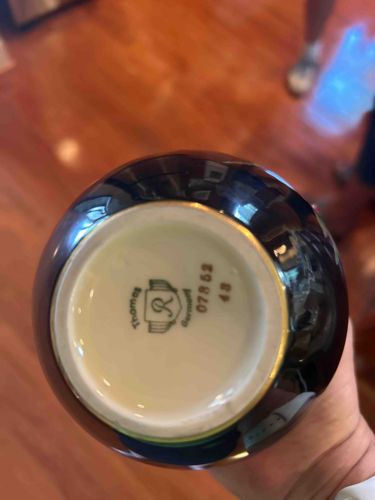
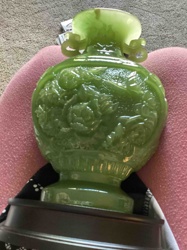
This is a ceramic vase, likely porcelain, manufactured by Thomas Germany. The vase exhibits a dark, possibly navy blue or black, glossy exterior glaze, which reflects light, indicating a smooth, polished finish. The rim of the vase, as seen from the top-down perspective, features a thin, metallic gold band, adding an element of elegance and accentuating the opening. The interior of the vase appears to be glazed in a contrasting light cream or off-white color.
The most distinctive features are located on the unglazed or less-glazed base of the interior, showcasing the manufacturer's mark. The mark consists of the word "Thomas" positioned vertically on the left, next to a detailed emblem featuring a stylized 'R' within a rectangular shield-like design, and the word "Germany" horizontally below the emblem. This mark suggests the item was produced post-WWII, when 'Germany' replaced 'West Germany' or 'East Germany' on many manufacturer stamps, placing its likely age from the mid-20th century to more contemporary times. Below the main mark, there are numerical markings: "07862" and "48", which likely represent a model number, pattern number, or internal production codes.
In terms of condition, the visible surfaces appear to be in good condition with no obvious chips, cracks, or significant abrasions. The glossy exterior finish seems intact, and the gold rim appears continuous. The craftsmanship appears to be of high quality, typical of German porcelain manufacturers known for precision and durability. The construction indicates a mass-produced, yet finely finished, decorative item.
AI Appraisal Report
Based on my visual examination of the provided image, this Thomas Germany porcelain vase appears to be in very good condition with no visible chips, cracks, or significant abrasions on the glossy exterior or gold rim. The distinct 'Thomas Germany' mark, with 'Germany' replacing 'West Germany' or 'East Germany', strongly suggests a post-WWII production, likely mid to late 20th century. The specific numbers "07862" and "48" are likely model or production codes.
In terms of market conditions, Thomas, a part of Rosenthal, produces high-quality, mass-produced porcelain. While well-regarded for craftsmanship, their decorative vases are generally not highly rare. Comparable Thomas Germany vases of similar size and condition typically sell in the secondary market for modest prices. Demand for such items is steady but not exceptionally high among collectors, rather appealing more to those seeking decorative home accents. Factors impacting value include the excellent apparent condition and the classic, versatile design. However, the lack of true rarity and the mass-produced nature limit its top-end value.
Limitations in authenticity verification from images alone exist. While the mark appears consistent with valid Thomas Germany stamps, an in-person examination would allow me to physically inspect the porcelain quality, weight, and the precise texture of the glaze, which can sometimes reveal inconsistencies if an item were not genuine. Provenance documentation, such as original sales receipts or family history, would also strengthen authentication. Scientific testing like thermoluminescence dating is not typically performed on items of this age and value range but could definitively date the piece if significant doubt existed.