These notes were written by the person who submitted this item. Appraiser.AI has not verified them, and the AI's identification and estimate may rely on them.
AI Estimated Value
Not an official valuation
$0-10
AI estimate as of November 2, 2025 · verify with a professional before acting
AI-Generated · Verify before acting
Everything on this page is generated by AI for informational purposes only. AI can make mistakes — the AI may misidentify items or misattribute them (artist, maker, brand, designer, origin, era). This is not an official valuation and should not be used for insurance, sale, tax, estate, legal, or lending purposes — or any decision requiring a certified appraisal. It is not an authoritative claim about any person, brand, or rights holder — do not share or rely on it as a factual statement about a third party. Always consult qualified professionals before making financial decisions.
This analysis also relies on unverified notes provided by the user, which may be incomplete or inaccurate and could affect the result.
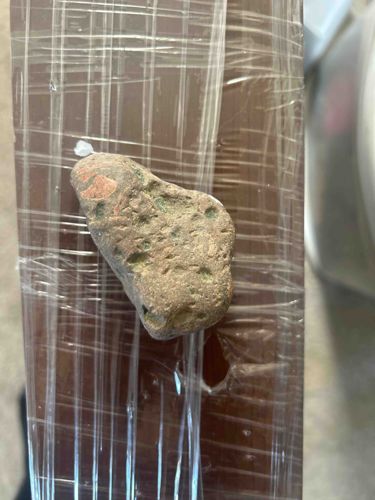
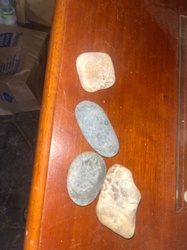
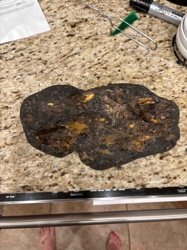
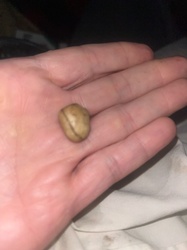
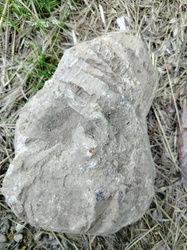
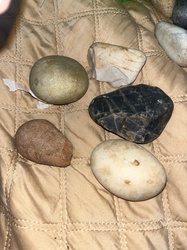
The item is a naturally formed stone or rock, characterized by its irregular, elongated, and somewhat flattened shape. It measures approximately 3-4 inches in its longest dimension, and exhibits a rough, textured surface with visible pitting and small indentations. The primary color is a muted reddish-brown or terracotta hue, suggestive of iron-rich mineral content, with notable patches of earthy green and darker brown discoloration, likely indicating lichen growth, moss, or mineral staining. Several lighter, possibly orange or pale red, mottled areas are visible on one end, contrasting with the overall darker tones. The stone appears to be sedimentary or metamorphic in origin, given its granular texture and varied coloring. There are no discernible maker's marks, signatures, or obvious signs of artificial modification, suggesting it is a natural specimen. The edges are rounded and smoothed, indicative of natural weathering processes such as water or wind erosion over an extended period. No overt fractures, chips, or repairs are immediately visible, but the surface exhibits a natural patina consistent with prolonged exposure to the elements. The quality is that of a typical natural rock, potentially collected from a riverbed, beach, or unearthed from soil. Its unique characteristics lie in its natural formation and the interplay of its various colors and textures.
AI Appraisal Report
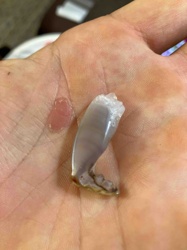
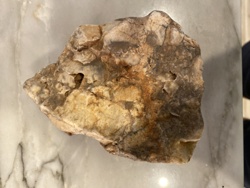
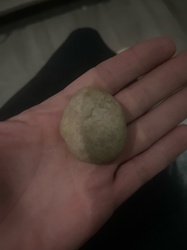
Upon examination of the provided images and description, the item presents as a naturally formed, weathered stone specimen. It measures approximately 3-4 inches and exhibits characteristics consistent with a common sedimentary or metamorphic rock that has undergone significant natural erosion. The coloration, a mix of reddish-brown, green, and earthy tones, is typical of rocks with iron content and surface colonization by lichen or moss. The surface appears intact, with no signs of artificial modification, and its condition is consistent with prolonged exposure to natural elements.
From a market perspective, this is considered a found object or natural curiosity. The value for such items is generally decorative or sentimental rather than intrinsic. The market for common, unclassified rocks is limited to hobbyists, crafters, or individuals seeking decorative stones for aquariums or terrariums. Supply is virtually unlimited, and there is no established secondary market for specimens of this nature unless they possess exceptional, scientifically significant, or aesthetically unique properties, none of which are apparent here. Consequently, the monetary value is nominal.
The key factor limiting its value is its commonality. Without features such as embedded fossils, rare crystal formations, or evidence of being a meteorite (aërolite), it holds no significant scientific or collector's value. My assessment is based entirely on visual inspection of the images. For a definitive valuation beyond its decorative potential, a physical examination by a geologist would be required to perform mineralogical analysis, test for density, and identify its precise geological origin. Such testing could reveal if it is an uncommon rock type or a meteorite, which would fundamentally alter its value, though this is highly unlikely based on the visual evidence.