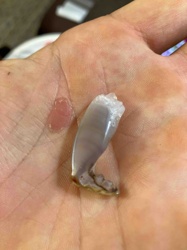
These notes were written by the person who submitted this item. Appraiser.AI has not verified them, and the AI's identification and estimate may rely on them.
AI Estimated Value
Not an official valuation
$50 - $150
AI estimate as of October 2, 2025 · verify with a professional before acting
AI-Generated · Verify before acting
Everything on this page is generated by AI for informational purposes only. AI can make mistakes — the AI may misidentify items or misattribute them (artist, maker, brand, designer, origin, era). This is not an official valuation and should not be used for insurance, sale, tax, estate, legal, or lending purposes — or any decision requiring a certified appraisal. It is not an authoritative claim about any person, brand, or rights holder — do not share or rely on it as a factual statement about a third party. Always consult qualified professionals before making financial decisions.
This analysis also relies on unverified notes provided by the user, which may be incomplete or inaccurate and could affect the result.
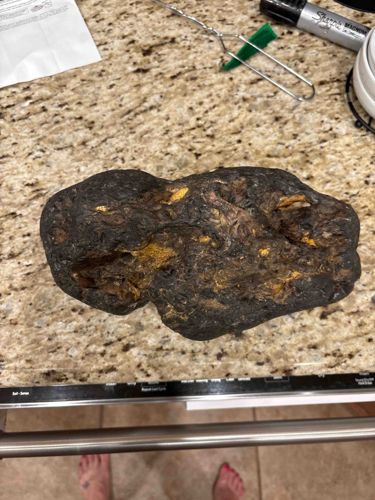
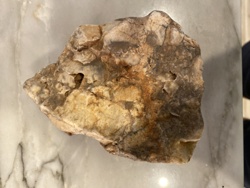
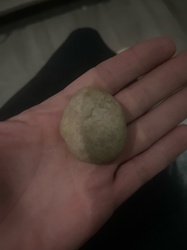
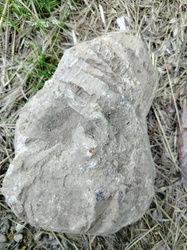
The item is a roughly oblong or amorphous specimen, characterized by a predominantly dark, almost black, color with significant patches and streaks of a vibrant, mustard-yellow to golden-brown hue. Its surface appears highly textured and irregular, suggesting a rough, perhaps fossilized or mineralized composition. The overall shape is organic and uneven, lacking any discernible geometric characteristics or indications of purposeful shaping. Physical characteristics suggest a density similar to rock or heavily compacted organic matter, given its appearance resting on a kitchen counter without distortion. There are no clear indications of a 'prehistoric animal skull' as suggested by the additional context; if this were a skull, it would be extremely fragmented, heavily mineralized, and lacking any recognizable cranial or facial structures. The golden-brown areas might be indicative of geological inclusions, oxidation, or possibly organic decomposition/mineralization. The texture appears somewhat lumpy and convoluted, with some areas showing a finer, almost powdery or granular surface, while others are more solid and rock-like. No clear craftsmanship or manufacturing marks are visible, suggesting a natural origin. The condition shows no visible signs of recent damage or repair, but its natural state is one of aged, weathered appearance. Without further analysis, its estimated age and specific composition remain speculative, but its appearance hints at geological or paleontological significance rather than a modern artifact. The significant discoloration and irregular form are its most distinguishing elements. It appears to be a natural specimen, possibly a heavily altered rock, a fossilized organic mass, or a mineral concretion.
AI Appraisal Report
Based on my visual examination of the provided image, this specimen is a fascinating, irregular organic or mineral mass, characterized by its dark, almost black primary color with striking mustard-yellow to golden-brown patches. The surface is highly textured and lumpy, indicative of a natural, unaltered origin. Despite the owner's suggestion, I see no discernible features consistent with a 'prehistoric animal skull.' If it were, it would be an extensively fragmented and heavily mineralized specimen, lacking any recognizable cranial structures. Its form is entirely organic and uneven, strongly suggesting a geological or heavily fossilized organic specimen rather than an artifact or a recognizable anatomical structure.
The condition appears stable, reflecting an aged and weathered natural state with no visible signs of recent damage or repair. Authenticity as a natural specimen seems clear; however, its specific composition and origin (e.g., mineral concretion, heavily altered rock, fossilized organic matter) cannot be definitively determined from images alone. To ascertain its true nature, an in-person examination, including potential geological or paleontological analysis (e.g., thin-section microscopy, elemental analysis), would be crucial.
Market conditions for such unidentifiable natural specimens are generally modest. Without a definitive identification as a rare fossil, meteor fragment, or specific mineral, demand is limited to individuals interested in unusual natural curiosities. Comparables would include aesthetically pleasing but unidentified rocks, concretions, or heavily weathered natural formations, typically fetching between $50 and $150. Its value is currently driven by its unique aesthetic appeal rather than any established scientific or historical significance, which remains entirely speculative without further analysis. The lack of provenance documentation also impacts its market value. Should advanced testing identify it as a rare fossil or mineral, its value could increase substantially.