These notes were written by the person who submitted this item. Appraiser.AI has not verified them, and the AI's identification and estimate may rely on them.
AI Estimated Value
Not an official valuation
$25 - $40
AI estimate as of November 9, 2025 · verify with a professional before acting
AI-Generated · Verify before acting
Everything on this page is generated by AI for informational purposes only. AI can make mistakes — the AI may misidentify items or misattribute them (artist, maker, brand, designer, origin, era). This is not an official valuation and should not be used for insurance, sale, tax, estate, legal, or lending purposes — or any decision requiring a certified appraisal. It is not an authoritative claim about any person, brand, or rights holder — do not share or rely on it as a factual statement about a third party. Always consult qualified professionals before making financial decisions.
This analysis also relies on unverified notes provided by the user, which may be incomplete or inaccurate and could affect the result.
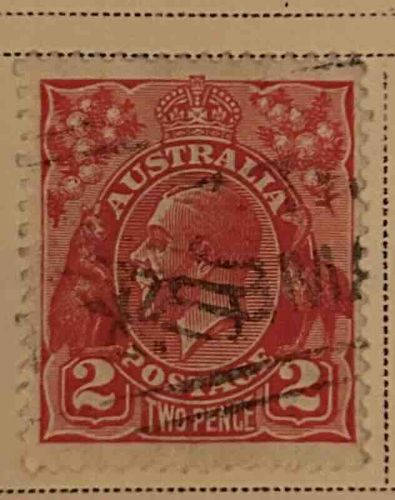
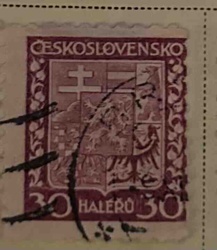
This item is an Australian postage stamp, specifically a 2 pence denomination, featuring a 'Kangaroo and Map' design, with a portrait of King George V. The stamp exhibits a primarily red color palette, possibly carmine or deep rose-red, printed on white paper. The central design prominently features a profile bust of King George V facing left, encircled by the word 'AUSTRALIA' at the top and 'POSTAGE' at the bottom. The numeral '2' is visible in both lower corners, with 'TWO PENCE' written below the central circle. The background imagery includes a kangaroo on the left and an emu on the right, flanking a stylized map of Australia, with floral ornamentation in the upper corners. A crown is depicted above the word 'AUSTRALIA'. The stamp is perforated along its edges, indicating it was separated from a sheet. Visible condition issues include a clear, probably circular, black postmark centrally located over the King's portrait, which obscures some of the facial details and the 'POSTAGE' inscription. The perforations appear largely intact, though the paper color suggests some age-related toning, or it could be the original paper stock color. The printing quality appears consistent with early 20th-century philatelic production, with fine lines and intricate details characteristic of intaglio or lithographic printing. The design itself, incorporating national symbols alongside the monarch's image, places it squarely within the British Commonwealth philatelic tradition of the early 20th century.
AI Appraisal Report
I have examined the provided image of the Australian 2 Pence 'Kangaroo and Map' postage stamp featuring King George V. Based on the visual evidence, the stamp appears to be an authentic example of this common issue, likely from the early 20th century. The design, printing quality, and color (consistent with carmine or deep rose-red) all align with known examples of this stamp. The perforations appear intact, which is a positive.
However, the primary factor significantly impacting its value is the heavy, centrally located black postmark. This postmark heavily obscures the King's portrait and the 'POSTAGE' inscription, which significantly detracts from its aesthetic appeal and philatelic desirability. While postmarks are expected on used stamps, a light, neatly applied cancellation that leaves the design clearly visible is preferred and commands higher value. The visible toning also suggests age, which is normal for stamps of this era but doesn't necessarily add value.
Market conditions for common, postmarked Australian Kangaroo and Map issues are generally moderate. While historically significant, many millions were printed, making them readily available. Rarity is low for such examples. Comparables for heavily cancelled examples typically range in the lower end of the spectrum. Demand is steady among general collectors but not intense for stamps in this condition.
It is crucial to note that this appraisal is based solely on the provided image. A full, in-person examination would be necessary to definitively confirm authenticity, assess paper thickness, watermarks, gum condition (if unused), and microscopic print details. Provenance documentation, such as where and when it was acquired, could also add to its overall historical context but would not significantly alter the monetary value of a common issue in this condition. Without physical inspection, I cannot rule out potential alterations, repairs, or re-gumming, although these are less common on lower-value items.