AI estimate as of October 16, 2025 · verify with a professional before acting
AI-Generated · Verify before acting
Everything on this page is generated by AI for informational purposes only. AI can make mistakes — the AI may misidentify items or misattribute them (artist, maker, brand, designer, origin, era). This is not an official valuation and should not be used for insurance, sale, tax, estate, legal, or lending purposes — or any decision requiring a certified appraisal. It is not an authoritative claim about any person, brand, or rights holder — do not share or rely on it as a factual statement about a third party. Always consult qualified professionals before making financial decisions.
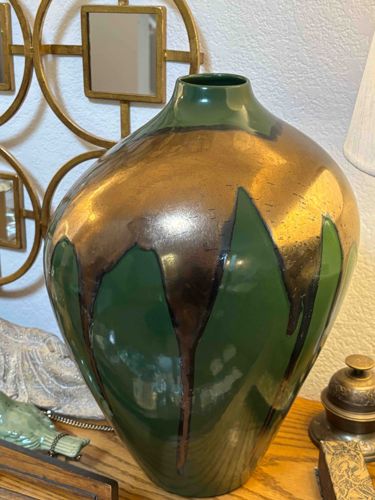
This is a substantial art pottery vase featuring a striking two-tone glaze. The vase has a bulbous, ovoid body that tapers to a narrower neck and a relatively small mouth. Its dominant colors are a deep, rich forest green and a shimmering metallic gold, which appears to be applied in an organic, dripping or flowing pattern. The green glaze forms the base color, covering the majority of the lower body and the interior of the neck. The metallic gold glaze is concentrated around the shoulder and upper body, with irregular, elongated drips extending downwards over the green background, creating a dynamic and somewhat abstract visual effect. The surface exhibits a high gloss finish, reflecting ambient light. There are no immediate visible signs of major cracks, chips, or repairs from the provided image; however, closer inspection would be required to ascertain any subtle surface imperfections or wear commensurate with age. The distinct application of glazes suggests a modern art pottery style, potentially from the mid to late 20th century or contemporary. The heavy, lustrous glazes and the bold color combination indicate a decorative piece designed for aesthetic impact. The craftsmanship appears to be of good quality, with an even glaze application in the green areas and a seemingly deliberate, artistic irregularity in the gold application. No obvious maker's marks or signatures are discernible in the photograph.
AI Appraisal Report
I've examined the provided image of this modern art pottery vase. Its bulbous, ovoid form transitioning to a narrower neck, combined with the two-tone metallic gold and forest green glaze, presents a decorative and aesthetically pleasing piece. The high-gloss finish and the organic, 'dripping' application of the gold over the green are characteristic of mid to late 20th-century or contemporary studio pottery, often designed for impact rather than utilitarian function. Visually, the condition appears good, with no obvious chips, cracks, or repairs, and the glaze application seems even in the green areas. However, this is based solely on the image; a physical inspection would be crucial to detect subtle crazing, hairline cracks, glaze skips, or professional repairs.
In terms of market conditions, modern decorative pottery, especially unsigned or unidentifiable studio pieces, typically falls into a broad category. While the piece is visually appealing, the absence of a discernible maker's mark significantly limits its value. Branded or artist-signed pieces from reputable studios or known artists command much higher prices. Without this, it's considered a decorative accent piece. Demand for such unsigned modern studio pottery is moderate. Its allure comes from its aesthetic appeal rather than rarity or historical significance. Factors significantly impacting value are the lack of maker attribution and the general availability of similar decorative pottery. To fully authenticate and determine its origin, an in-person examination for impressed or painted marks, a blacklight test for repairs, and potentially XRF analysis for glaze composition would be necessary. Without these, it remains a charming but unattributed decorative art pottery vase.