AI estimate as of December 13, 2025 · verify with a professional before acting
AI-Generated · Verify before acting
Everything on this page is generated by AI for informational purposes only. AI can make mistakes — the AI may misidentify items or misattribute them (artist, maker, brand, designer, origin, era). This is not an official valuation and should not be used for insurance, sale, tax, estate, legal, or lending purposes — or any decision requiring a certified appraisal. It is not an authoritative claim about any person, brand, or rights holder — do not share or rely on it as a factual statement about a third party. Always consult qualified professionals before making financial decisions.
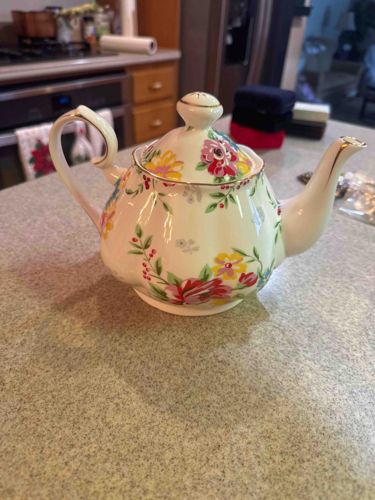
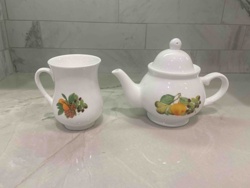
This is a ceramic teapot adorned with a vibrant floral chintz-style pattern. The primary body of the teapot is a creamy off-white or very pale yellow, providing a soft background for the colorful decoration. The floral motif features an array of blossoms in shades of red, yellow, pink, and possibly light blue, interspersed with green leaves and small red berries, giving it a lush, garden-like appearance. The pattern is irregularly spread across the body and lid of the teapot, suggesting a somewhat freehand or artistic application rather than a rigid, repeating pattern. The teapot has a classic, rounded silhouette, tapering slightly towards the base and neck. Both the handle and spout are gracefully curved, with the handle appearing to be a single, substantial loop that connects near the top and midway down the body. A distinguishing feature is the gold gilt trim, which accents the rim of the lid, the finial, the tip of the spout, and the upper curve of the handle, adding a touch of elegance and luxury. The lid is domed with a small, rounded finial for easy lifting. The overall condition appears to be very good with no obvious chips, cracks, or significant wear visible from the provided images. The gold trim seems largely intact, indicating careful handling. The style suggests a mid-20th century to contemporary production, possibly influenced by traditional English chintz designs. There are no visible maker's marks or signatures in the images provided, which would typically be found on the base. The craftsmanship appears to be good quality, with smooth glazing and consistent application of the decorative elements. The base of the teapot is a flat, unglazed ring.
AI Appraisal Report
I have visually examined this Floral Chintz-Style Teapot. The condition appears to be very good, with no obvious chips, cracks, or significant wear visible in the images. The gold gilt trim, which adds an elegant touch to the lid, finial, spout, and handle, seems largely intact, indicating careful handling. This style suggests a mid-20th century to contemporary production, likely influenced by traditional English chintz designs. The craftsmanship appears good, with smooth glazing and consistent application of the vibrant floral pattern.
Market conditions for chintz-style teapots are generally stable, with demand often driven by collectors of decorative ceramics or those seeking a particular aesthetic for home decor. While charming, pieces without clear maker's marks or significant age rarely command high values unless attributed to a highly sought-after manufacturer. Comparables for unsigned, good condition chintz-style teapots typically fall within the $40-70 range. Factors impacting value include the lack of a visible maker's mark, which prevents attribution to a known manufacturer and thus limits potential rarity. The aesthetic appeal and good condition are positive factors.
Limitations in authenticity verification from images alone are significant. My assessment of condition is based solely on visual cues; an in-person examination would be needed to confirm the absence of hairline cracks, crazing, repairs, or wear not visible in photographs. Provenance documentation, such as original sales receipts or family history, could help establish its age and origin. Scientific testing, while unlikely for an item of this value, could verify material composition if specific concerns arose. Without physical inspection or maker's marks, definitive attribution and full authentication are not possible.