These notes were written by the person who submitted this item. Appraiser.AI has not verified them, and the AI's identification and estimate may rely on them.
AI Estimated Value
Not an official valuation
$120-200
AI estimate as of July 8, 2025 · verify with a professional before acting
AI-Generated · Verify before acting
Everything on this page is generated by AI for informational purposes only. AI can make mistakes — the AI may misidentify items or misattribute them (artist, maker, brand, designer, origin, era). This is not an official valuation and should not be used for insurance, sale, tax, estate, legal, or lending purposes — or any decision requiring a certified appraisal. It is not an authoritative claim about any person, brand, or rights holder — do not share or rely on it as a factual statement about a third party. Always consult qualified professionals before making financial decisions.
This analysis also relies on unverified notes provided by the user, which may be incomplete or inaccurate and could affect the result.
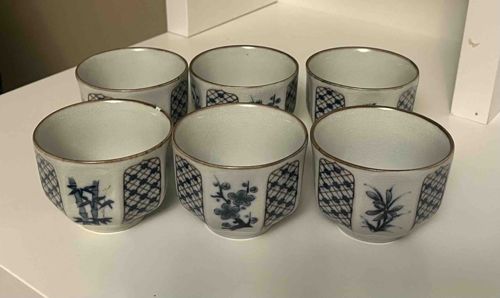
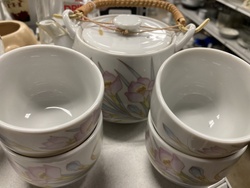
This set consists of six Japanese tea cups, likely yunomi or chawan for green tea, made from ceramic or porcelain with a visible blue and white underglaze decoration. Each cup appears to be approximately 3-4 inches in height and diameter, with a slightly tapering body that broadens towards the rim and a small, stable foot. The exterior of each cup is adorned with alternating panels of decorative patterns. Some panels feature intricate, dark blue geometric patterns resembling a diamond lattice or basket-weave design, while others display hand-painted floral or botanical motifs in a similar rich blue hue. Specific motifs include what appears to be bamboo stalks on one cup, blooming plum blossoms on another, and perhaps iris or other grasses on a third. The interior of the cups is a clean, off-white or cream color. The rim of each cup has a subtle, narrow brown or rust-colored line, providing a finished edge. The craftsmanship suggests these are of good quality, possibly hand-painted given the slight variations in motifs between cups. There are no obvious signs of significant damage like chips or cracks, but there might be minor wear consistent with use and age, such as slight discoloration on the rim or very fine crazing visible only upon close inspection. Given the traditional Japanese patterns and the known origin ('Made in Japan'), these cups likely date from the mid to late 20th century. The style is classic Japanese wabi-sabi, emphasizing natural simplicity and aesthetic imperfections.
AI Appraisal Report
Upon my virtual examination of the provided image and details for this Set of Six Japanese Blue and White Tea Cups, I assess their condition as very good for their apparent age. The description notes no obvious chips or cracks, which is crucial for maximizing value in ceramics. Minor wear, such as slight discoloration on rims or fine crazing, is expected and generally doesn't significantly detract from value unless severe.
Authenticity: Based on the traditional patterns, 'Made in Japan' origin, and overall aesthetic described, these cups appear to be authentic Japanese ceramic tea wares. The varied hand-painted motifs suggest good quality craftsmanship, likely from the mid to late 20th century.
Market Conditions & Comparables: The market for Japanese blue and white ceramics, particularly tea wares, is consistently strong. Pieces with traditional motifs like bamboo and plum blossoms are popular. Similar sets of yunomi or chawan in good condition typically fetch between $80 and $250, depending on the artist, specific period, and overall decorative quality. The 'wabi-sabi' aesthetic, emphasizing simplicity and natural imperfection, resonates well with collectors. Demand for such functional and decorative art pieces is stable. These cups are not rare; however, a complete set in excellent condition with appealing, varied designs adds to market desirability.
Factors Impacting Value: The completeness of the set (all six cups), the apparent excellent condition (no significant damage), and the attractive hand-painted underglaze decoration are primary value drivers. The 'Made in Japan' mark, while indicating origin, does not inherently elevate value beyond typical examples unless associated with a particularly renowned kiln or artist. The slight variations in motifs between cups enhance their artisanal appeal.
Limitations: My assessment is based solely on the provided image and textual description. A definitive authentication and full condition report would require a physical inspection to check for subtle damage (hairline cracks, repairs, extensive crazing), precise material composition, and to properly identify any maker's marks that might be present on the base. Provenance documentation (e.g., original purchase receipts, prior ownership history) would also provide invaluable context for the cups' history and authenticity.