These notes were written by the person who submitted this item. Appraiser.AI has not verified them, and the AI's identification and estimate may rely on them.
AI Estimated Value
Not an official valuation
$800 - $1,500
AI estimate as of August 31, 2025 · verify with a professional before acting
AI-Generated · Verify before acting
Everything on this page is generated by AI for informational purposes only. AI can make mistakes — the AI may misidentify items or misattribute them (artist, maker, brand, designer, origin, era). This is not an official valuation and should not be used for insurance, sale, tax, estate, legal, or lending purposes — or any decision requiring a certified appraisal. It is not an authoritative claim about any person, brand, or rights holder — do not share or rely on it as a factual statement about a third party. Always consult qualified professionals before making financial decisions.
This analysis also relies on unverified notes provided by the user, which may be incomplete or inaccurate and could affect the result.
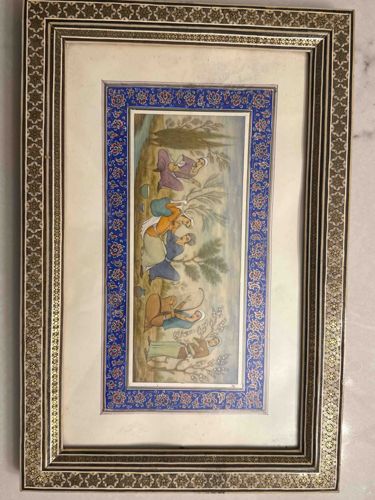
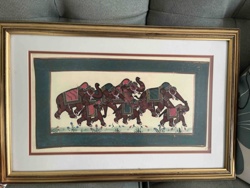
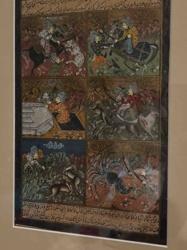
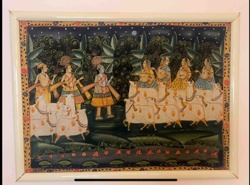
This item is a framed Persian miniature painting, executed on what is described as bone, depicting a dynamic scene with several figures in a landscape. The miniature itself is rectangular and vertically oriented, showcasing a lush, somewhat stylized natural setting with trees and a suggestion of water. Five primary figures are visible, dressed in traditional Persian attire with a vibrant palette of blues, oranges, purples, and greens. Their poses suggest movement or activity, possibly hunting or a leisurely scene. The painting exhibits fine brushwork typical of Persian miniatures, with intricate details in the clothing and facial features, though these are somewhat obscured by the image resolution. The colors appear to be well-preserved with some minor tonal shifts suggesting age and possibly a slight patina on the surface. Around the miniature, there is a prominent inner border in a rich cobalt blue, adorned with repeating floral or quatrefoil motifs in gold or a lighter contrasting color. This inner border is then set within a wider, plain ivory-colored mat. The entire piece is encapsulated in a decorative wooden frame. The frame features an intricate geometric pattern, possibly micro-mosaic or inlay work, with a repeating star-like motif in contrasting dark and light (likely bone or mother-of-pearl) materials, creating a visually striking border. The craftsmanship of the frame indicates a high level of artisanal skill. No specific maker's marks or signatures are discernible from the provided images. Given the style of the artwork and the framing, it likely dates from the 19th or early 20th century. The visible condition appears good, with no overt damage or significant wear to the miniature itself, and the frame seems intact.
AI Appraisal Report
Based on my examination of the image of this Framed Persian Miniature Painting on Bone, I can offer the following appraisal. The miniature itself appears to be in good condition, with vibrant colors and intricate details consistent with 19th to early 20th-century Persian miniatures. The description of it being painted on bone is intriguing and, if confirmed, adds a unique characteristic; however, without physical inspection, I cannot definitively verify the substrate. The elaborate frame, likely micro-mosaic or inlay, significantly enhances the piece's aesthetic appeal and value, indicating high craftsmanship.
From a market perspective, Persian miniatures, especially those with good detail and condition, maintain steady demand among collectors of Islamic art. Miniatures on unusual substrates like bone are less common, which can increase rarity and desirability. Comparables generally range from a few hundred to several thousand dollars, depending on artist attribution, age, and overall artistic merit. This piece, with its appealing scene and elaborate framing, falls comfortably within the mid-range.
However, it is crucial to state that a full authentication would require in-person examination. I can assess condition and stylistic authenticity from the image, but definitive authentication of the 'on bone' claim, verification of the painting's age, and confirmation of the frame's material (e.g., bone or mother-of-pearl inlay) would necessitate a physical inspection. Furthermore, the absence of artist signatures or provenance documentation limits the ability to attribute it to a specific master, which would otherwise significantly increase its value. Without this, it is valued as a decorative art piece of quality rather than a signed work by a known artist.