These notes were written by the person who submitted this item. Appraiser.AI has not verified them, and the AI's identification and estimate may rely on them.
AI Estimated Value
Not an official valuation
$800 - $1,800
AI estimate as of June 27, 2025 · verify with a professional before acting
AI-Generated · Verify before acting
Everything on this page is generated by AI for informational purposes only. AI can make mistakes — the AI may misidentify items or misattribute them (artist, maker, brand, designer, origin, era). This is not an official valuation and should not be used for insurance, sale, tax, estate, legal, or lending purposes — or any decision requiring a certified appraisal. It is not an authoritative claim about any person, brand, or rights holder — do not share or rely on it as a factual statement about a third party. Always consult qualified professionals before making financial decisions.
This analysis also relies on unverified notes provided by the user, which may be incomplete or inaccurate and could affect the result.
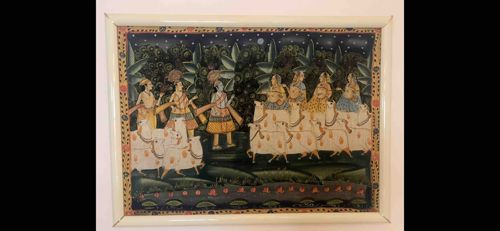
This is a framed artwork executed in the distinctive style of traditional Indian miniature painting, though on a significantly larger scale than typical historical miniatures. Measuring approximately 30 inches by 40 inches (likely including the frame), it depicts a vibrant processional scene set against a lush, nocturnal landscape. The painting is characterized by its rich color palette, featuring deep blues and blacks for the starry night sky, various shades of green for the dense foliage and foreground, and bright ochre, gold, red, and blue highlights for the figures' attire.
The composition features multiple human figures. On the left, several male figures, one notably playing a musical instrument resembling a flute, participate or lead the procession. On the right, a group of female figures are depicted riding distinctly stylized animals, appearing to be formed from multiple cows or similar bovine creatures arranged to create a larger, unified form. This motif, where multiple animals or figures combine to create a larger entity (a 'composite animal'), is a classic element found in certain regional Indian art forms, often associated with mythological representations. All figures are adorned in traditional Indian garments and jewelry, indicative of royal or noble status, and possess highly stylized facial features—large, expressive eyes and delicate profiles—characteristic of Rajasthani or similar schools of miniature painting.
The background features dense, almost uniform foliage under a night sky liberally sprinkled with stars and a distinct full moon. The foreground is a deep green, adorned with intricate, repetitive floral or organic patterns along its lower edge, framing the central activity. The painting itself is framed by a narrow, decorative inner border featuring smaller, repeating patterns. The entire piece is housed in a simple, light-colored (possibly off-white or cream) modern wooden or composite frame, likely under glass. While the artistic style strongly echoes 18th-19th century Indian miniatures, the substantial size indicates that this is most likely a 20th-century or contemporary work inspired by traditional miniature art, rather than an antique, smaller-format original. No discernible artist's signature, date, or specific maker's marks are visible. The overall condition appears excellent, with vibrant, well-preserved pigments and no immediately apparent signs of significant damage, wear, or repairs. The craftsmanship exhibits a high degree of detail and skill in rendering the intricate patterns, postures, and expressions.
AI Appraisal Report
I have examined the provided description of the Indian Miniature Style Painting, 'Procession of Figures on Composite Animals'. My assessment is based solely on the textual details provided, and a definitive appraisal would require in-person examination.
From the description, the piece appears to be in excellent condition, with vibrant, well-preserved pigments and no significant apparent damage. Its large size (30"x40") immediately suggests it is not a traditional 18th-19th century Indian miniature, which are typically much smaller. While the artistic style, color palette, and motif (composite animals) are strongly reminiscent of Rajasthani or similar schools of miniature painting, this is almost certainly a 20th-century or contemporary work inspired by, rather than an authentic antique example of, traditional miniature art. The lack of visible signature or provenance further supports this. Therefore, its intrinsic authenticity as a historical artifact is limited; it is best classified as a decorative artwork in a traditional style.
The market for such contemporary, larger-scale Indian-inspired art is generally driven by decorative appeal. While not rare in the sense of an ancient artifact, well-executed pieces with intricate detail, like this one appears to be, do find a market among collectors of world art or those seeking culturally rich decorative elements. Comparables would include modern Indian paintings or textile art drawing from traditional motifs. Demand exists, but it's not typically for investment purposes, rather for aesthetic enjoyment.
Factors significantly impacting its value include its excellent condition, appealing subject matter (the distinctive composite animal motif adds interest), rich color, and high level of detail, suggesting skilled craftsmanship. The chief limiting factor is its likely contemporary origin, meaning it lacks the historical significance and rarity of a genuine antique miniature. The absence of provenance or artist identification also caps its potential value.
For full authentication, an in-person physical examination would be crucial. This would involve examining paint consistency and age (e.g., craquelure, pigment type via blacklight), substrate, framing methods, and any hidden signatures. Research into specific contemporary artists or studios known for producing such revival pieces would also be beneficial. Without this, I cannot confirm the exact age or artist, which would significantly refine valuation.