Photo and notes provided by the user — not generated by AI
Submitted photo · May 27, 2026
User's notes
No additional notes provided.
AI analysis below
AI appraisal
AI analysis & estimate
AI-Generated · Verify before acting
Everything below is generated by AI for informational purposes only. AI can make mistakes — the AI may misidentify items or misattribute them (artist, maker, brand, designer, origin, era). This is not an official valuation and should not be used for insurance, sale, tax, estate, legal, or lending purposes — or any decision requiring a certified appraisal. It is not an authoritative claim about any person, brand, or rights holder — do not share or rely on it as a factual statement about a third party. Always consult qualified professionals before making financial decisions.
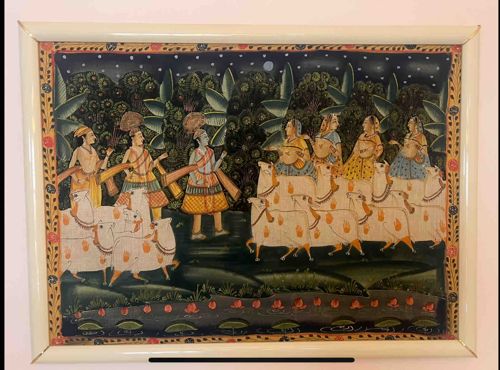
This exquisite artwork is an Indian miniature painting, elegantly framed within a simple, rectangular, light-toned frame, likely made of wood or a similar molded material, finished in a cream or off-white hue. The painting itself is rendered on what appears to be paper or a thin board, displaying a rich palette of deep greens, dark blues, vibrant yellows, oranges, and whites. The dimensions appear to be consistent with traditional miniature formats, designed for close appreciation.
The central scene depicts a nocturnal pastoral or mythological procession. On the left, several male figures, dressed in traditional Indian attire including dhotis and turbans, move forward; one figure in the center has distinctive blue skin, highly suggestive of Krishna. These figures appear to be leading animals or carrying implements. On the right, a charming group of female figures, commonly identified as Gopis, are mounted on white sheep or goats, each animal featuring distinctive orange-red markings, possibly decorative. The Gopis are depicted holding various stringed musical instruments, such as lutes or sitars, indicating a musical procession.
The background is a dense, stylized forest or jungle, rendered with intricate green foliage, set against a dark blue night sky illuminated by a crescent moon and scattered white stars. The foreground includes a body of water adorned with stylized lotus flowers. The visible condition of the painting is remarkably good, with vivid and well-preserved colors, strong detail, and no apparent significant damage such as tears, creases, or substantial paint loss. The fine brushwork, detailed ornamentation on the figures' clothing, and the harmonious composition speak to a high level of craftsmanship. While no specific maker's marks or signatures are discernible in the provided image, the style, subject matter, and execution are characteristic of 19th or early 20th-century Indian miniature painting, possibly from a Rajasthani school, known for its narrative and devotional themes. The piece conveys a serene and mystical ambiance.
AI Appraisal Report
·AI can make mistakes·Verify before acting
Based on my visual examination of the provided images, this Indian miniature painting exhibits remarkable condition, displaying vibrant colors and intricate detail with no apparent significant damage such as tears, creases, or substantial paint loss. The framing appears simple and complementary. The style, subject matter (Krishna and Gopis), and fine brushwork are highly consistent with 19th or early 20th-century Rajasthani schools of miniature painting, known for their devotional and narrative themes.
The market for quality Indian miniatures remains stable, with consistent demand for well-preserved narrative pieces. While not exceptionally rare, a piece of this visual quality and classic subject matter holds appeal. Its strong compositional elements, detailed execution, and excellent preservation are significant value drivers.
However, a definitive appraisal is limited by image-only assessment. Authenticity of age and origin cannot be fully verified without in-person examination. I would need to physically inspect the paper, pigments, and underlying layers for condition, age indicators, and any repairs. Crucially, provenance documentation (history of ownership) is vital for authentication and establishing a higher value. Scientific testing, like pigment analysis or carbon dating, could further confirm authenticity and era. Without these, the value remains an estimate based solely on visual attributes and likely age.