These notes were written by the person who submitted this item. Appraiser.AI has not verified them, and the AI's identification and estimate may rely on them.
AI Estimated Value
Not an official valuation
$5 - $15
AI estimate as of November 10, 2025 · verify with a professional before acting
AI-Generated · Verify before acting
Everything on this page is generated by AI for informational purposes only. AI can make mistakes — the AI may misidentify items or misattribute them (artist, maker, brand, designer, origin, era). This is not an official valuation and should not be used for insurance, sale, tax, estate, legal, or lending purposes — or any decision requiring a certified appraisal. It is not an authoritative claim about any person, brand, or rights holder — do not share or rely on it as a factual statement about a third party. Always consult qualified professionals before making financial decisions.
This analysis also relies on unverified notes provided by the user, which may be incomplete or inaccurate and could affect the result.
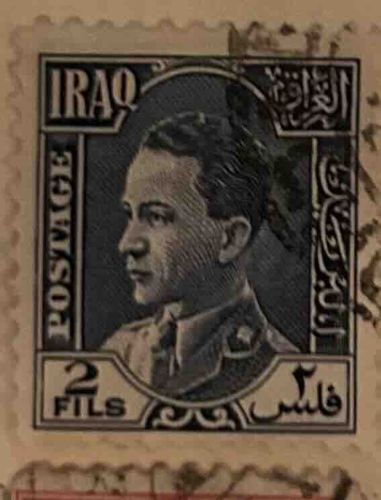
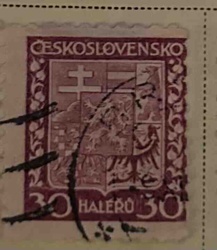
This is a vintage postage stamp from Iraq, featuring a portrait of King Faisal II. The stamp is predominantly blue and off-white/light tan in color, with a rectangular shape and perforated edges, indicating it is likely an individual stamp rather than part of a sheet. The central image is a profile bust of a young man, presumably King Faisal II, facing left, rendered in fine detail through what appears to be an intaglio or similar printing method, showcasing subtle shading and line work. He is depicted wearing a military or royal uniform with epaulets and a collar adornment. The word "IRAQ" is prominently displayed in English at the top left corner, above the word "POSTAGE" which runs vertically along the left edge. In the top right corner, Arabic script, likely translating to 'Iraq', is visible. The denomination '2 FILS' is clearly printed in English in the bottom left, mirrored by 'فلس ٢' in Arabic script on the bottom right. The design incorporates decorative borders with stylized filigree patterns, especially along the right side and framing the central portrait. The overall condition shows some minor wear consistent with its age, including slight discoloration on the borders and potentially some minor scuffs, but the central image and text remain remarkably clear and well-defined. The perforation indicates a manufacturing style common in the mid-20th century. The details suggest quality craftsmanship typical for national postal emissions.
AI Appraisal Report
Upon examining the provided image of the Iraq 2 Fils King Faisal II postage stamp, I find it to be an authentic example of a mid-20th century Iraqi postal issue. The design, including the portrait of King Faisal II, the denominations in English and Arabic, and the 'IRAQ POSTAGE' text, aligns perfectly with known specimens. The printing quality, showing fine detail and shading, is consistent with the intaglio process common for this period. Authenticity, based on visual cues alone, appears robust; however, a definitive confirmation would require a physical examination to verify paper type, watermarks (if any), and printing methods, which are not discernible from images.
Concerning the condition, the stamp exhibits minor wear consistent with its age. I note slight discoloration on the borders and what appear to be minor scuffs. Crucially, the central image and all textual elements remain clear and well-defined, and the perforations appear intact, though a closer inspection would be needed to assess individual teeth. This condition would generally be rated as 'Fine-Very Fine' or 'Used Fine', depending on the exact extent of the imperfections.
In terms of market conditions, stamps featuring King Faisal II are not particularly rare, especially common denominations like the 2 Fils. There is a consistent but not exceptionally high demand for them among Middle Eastern and British Commonwealth stamp collectors. Comparable sales for similar stamps in this condition typically fall within the $5 to $15 range. Factors impacting this value include the common denomination, the 'used' nature (indicated by the lack of a prominent gummed back, though not fully verifiable from the image), and the noted minor imperfections. A pristine, unmounted mint example would command a higher price. To confirm the 'used' status, I would need to physically inspect the back for hinge remnants or cancellation marks. For full authentication and a more precise value, physical examination, including expert evaluation of paper, printing, and gum (if any), is essential, along with a review of any associated provenance documentation.