AI Appraisal Estimate

AI-generated estimates · not official valuations

From the user

What was submitted

Photo and notes provided by the user — not generated by AI

Submitted item photo
Submitted photo · June 17, 2026

User's notes

Japan

AI analysis below

AI appraisal

AI analysis & estimate

AI-Generated · Verify before acting

Everything below is generated by AI for informational purposes only. AI can make mistakes — the AI may misidentify items or misattribute them (artist, maker, brand, designer, origin, era). This is not an official valuation and should not be used for insurance, sale, tax, estate, legal, or lending purposes — or any decision requiring a certified appraisal. It is not an authoritative claim about any person, brand, or rights holder — do not share or rely on it as a factual statement about a third party. Always consult qualified professionals before making financial decisions.

Note

This analysis also relies on unverified notes provided by the user, which may be incomplete or inaccurate and could affect the result.

Read the full disclaimer

AI Identification

·Not independently authenticated·Verify before acting

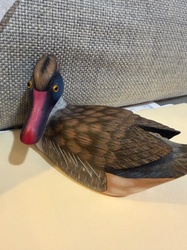
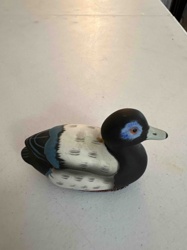
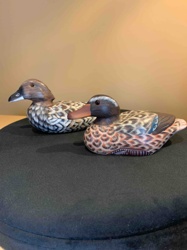
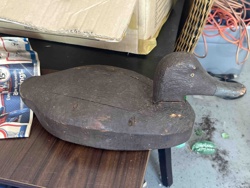
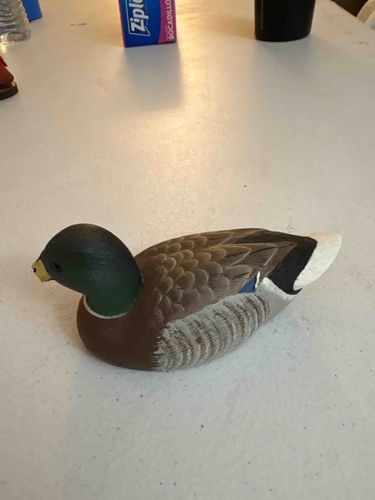
Miniature Carved and Painted Wood Mallard Drake Decoy

Collectibles / Sporting Goods / Decorative Decoys

AI Estimated Value

·Not an official valuation·Verify before acting

$15-25

As of June 17, 2026

AI Item Analysis

·AI can make mistakes·Verify before acting
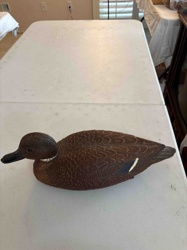
This item is a decorative wood carving of a male mallard duck (drake), likely produced in Japan for the export market during the mid-to-late 20th century. The piece is constructed from a lightweight wood with a smooth, matte-painted finish. Physically, it features a distinct green head with a yellow bill, a white neck ring, and a brownish-chestnut breast. The body showcases hand-painted or stencil-assisted feather detailing in shades of grey, tan, and brown, topped with a dark wing patch featuring a blue speculum highlight. The tail is ivory-white, consistent with mallard plumage. The carving exhibits a simplified, folk-art style with soft contours and lacks realistic glass eyes, instead utilizing painted black dots for eyes. The condition appears fair to good; there is visible paint wear on the tip of the bill and subtle scuffing along the lower edges of the body, typical for a vintage decorative object. While no maker's marks are visible on the top surface, such items from Japan typically bore a gold or silver foil sticker on the flat base indicating 'Made in Japan.' The craftsmanship is uniform and commercial in nature, suggesting it was part of a series intended for shelf display or as a collector's knick-knack rather than a functional hunting decoy.
AI Appraisal Report

·AI can make mistakes·Verify before acting
I have examined the provided images and descriptions of this miniature mallard drake decoy. This piece is a mass-produced decorative object, consistent with export ware manufactured in Japan during the 1960s and 1970s. The simplified carving style, lightweight wood, and painted eye dots indicate this was intended for the 'curio' or giftware market rather than for functional use or high-end sporting art collections. The condition is fair to good, with notable paint loss on the bill and minor abrasions on the body. Because these items were produced in high volumes, such wear significantly impacts value, as mint-condition examples are readily available. Market demand for Japanese export decoys is currently low, as collectors of sporting goods typically prioritize domestic makers (e.g., Mason or Wildfowler) or documented folk artists. Comparable sales on secondary markets like eBay or Etsy consistently show these miniatures selling for under $30. While the aesthetic and description align perfectly with a mid-century Japanese provenance, I must note that a definitive attribution is limited by the absence of a 'Made in Japan' foil label or stamp on the underside. To fully authenticate the piece and rule out later 20th-century reproductions from other regions, an in-person inspection of the base for adhesive residue or specific woodworking tool marks would be required. Furthermore, provenance documentation or original packaging would be necessary to elevate its status beyond a common decorative knick-knack. Scientific testing is not warranted for an item of this market value.

Get your items appraised

Instant estimates of your treasures with AI-powered appraisals

Browse More Appraisals