Vintage Hand-Carved Wooden Duck Decoy
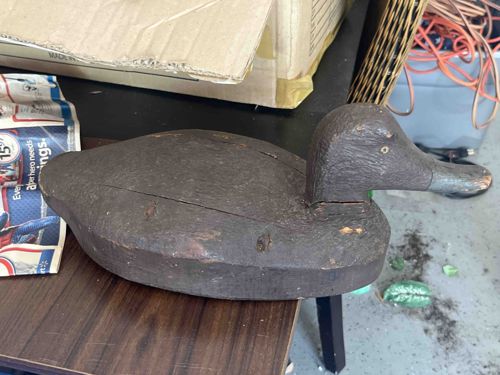
This is a vintage, folk-art style duck decoy, likely representing a black duck or a hen mallard. It is constructed from solid wood with a distinct two-piece design where the head is joined to the body. The carving is utilitarian rather than decorative, showcasing a flat-bottomed profile designed for water stability. The piece is finished in a dark, umber-toned paint that appears to be an old, possibly original, working surface. The craftsmanship is rustic, featuring simplified anatomical details like a broad bill and basic eye sockets. Notably, the item exhibits significant age-related wear, including a prominent longitudinal crack running across the back, scattered wood losses (chips) near the bill and tail, and several areas of paint thinning that reveal the wood grain beneath. There are visible fasteners or dowels on the side of the body, likely used for structural reinforcement or weight attachment. The texture of the wood suggests a mid-20th-century origin, characterized by a heavy patina and authentic field use. Its primitive aesthetic and weathered condition are hallmarks of early hunting gear repurposed as Americana collectibles.

AI-Generated Appraisal Disclaimer
Estimated Value
$150-250
Basic Information
Category
Folk Art / Sporting Collectibles
Appraised On
March 22, 2026
Estimated Value
$150-250
Item Description
This is a vintage, folk-art style duck decoy, likely representing a black duck or a hen mallard. It is constructed from solid wood with a distinct two-piece design where the head is joined to the body. The carving is utilitarian rather than decorative, showcasing a flat-bottomed profile designed for water stability. The piece is finished in a dark, umber-toned paint that appears to be an old, possibly original, working surface. The craftsmanship is rustic, featuring simplified anatomical details like a broad bill and basic eye sockets. Notably, the item exhibits significant age-related wear, including a prominent longitudinal crack running across the back, scattered wood losses (chips) near the bill and tail, and several areas of paint thinning that reveal the wood grain beneath. There are visible fasteners or dowels on the side of the body, likely used for structural reinforcement or weight attachment. The texture of the wood suggests a mid-20th-century origin, characterized by a heavy patina and authentic field use. Its primitive aesthetic and weathered condition are hallmarks of early hunting gear repurposed as Americana collectibles.

Related Tags
Get Your Items Appraised
Instant estimates of your treasures with AI-powered instant appraisals