These notes were written by the person who submitted this item. Appraiser.AI has not verified them, and the AI's identification and estimate may rely on them.
AI Estimated Value
Not an official valuation
$40-60
AI estimate as of October 12, 2025 · verify with a professional before acting
AI-Generated · Verify before acting
Everything on this page is generated by AI for informational purposes only. AI can make mistakes — the AI may misidentify items or misattribute them (artist, maker, brand, designer, origin, era). This is not an official valuation and should not be used for insurance, sale, tax, estate, legal, or lending purposes — or any decision requiring a certified appraisal. It is not an authoritative claim about any person, brand, or rights holder — do not share or rely on it as a factual statement about a third party. Always consult qualified professionals before making financial decisions.
This analysis also relies on unverified notes provided by the user, which may be incomplete or inaccurate and could affect the result.
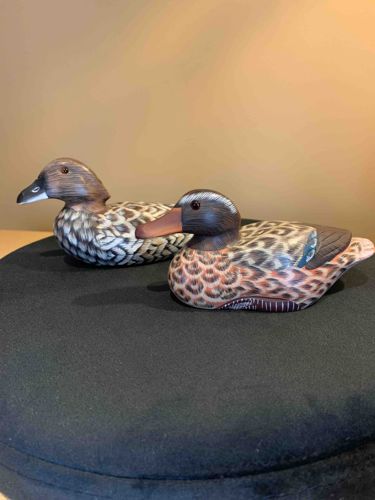
This item consists of a pair of hand-painted wooden duck figurines, likely intended as decorative collectibles rather than functional hunting decoys, given their detailed painting and apparent lack of weighting or attachment points. The ducks are depicted in a resting or swimming posture. One duck, positioned to the left, appears to be a female (hen) with a predominantly brown and tan coloration, featuring intricate feather detailing in white, brown, and black. Its head is a muted brown, and the beak is dark. The second duck, on the right, is a male (drake), characterized by a darker head with a distinct iridescent bluish-green band across the eye, leading to a dark brown body with lighter, intricately painted feather patterns in shades of brown, black, and rust. Both ducks exhibit finely scaled feather patterns across their backs and sides, suggesting a high level of craftsmanship in the painting. The bodies appear to be solid wood, smoothly carved. The construction shows no obvious visible flaws or damage such as chips, cracks, or significant paint loss, indicating good preservation. There are no discernible maker's marks or signatures visible in the provided image. The overall style suggests a mid to late 20th-century decorative item, possibly produced in the Public Republic of China, as per the additional context. The quality of the hand-painting, particularly the detailed feathering, indicates a level of artisanal effort.
AI Appraisal Report
Upon examining the images provided, this pair of hand-painted wooden duck figurines presents as decorative collectibles in very good condition. The carving is smooth, and the paintwork, particularly the detailed feather patterns on both the drake and the hen, demonstrates a notable level of artisanal skill. I observed no significant chips, cracks, or paint loss, which speaks to their good preservation. The style is consistent with decorative arts produced in the mid to late 20th century.
The stated origin, the People's Republic of China, is a critical factor influencing the value. While well-crafted, these pieces are part of a large market of decorative wooden birds produced for export. They are not antique American or European folk art decoys by known carvers, which command significantly higher prices. The market for these specific decorative imports is driven by their aesthetic appeal rather than rarity or historical significance. Current market conditions show a wide availability of similar hand-carved wooden ducks from China, with comparable sales typically falling in the $20 to $30 range per piece.
The primary factor limiting the value is their origin and lack of a known maker. Though visually appealing, they are not considered rare. For full authentication, an in-person examination would be required to inspect for any hidden maker's marks, analyze the wood type and age, and confirm the specific paint materials used. Without direct inspection or provenance, I must base my valuation on the assumption that these are well-made, but mass-produced decorative items.