These notes were written by the person who submitted this item. Appraiser.AI has not verified them, and the AI's identification and estimate may rely on them.
AI Estimated Value
Not an official valuation
$5 - $15
AI estimate as of November 10, 2025 · verify with a professional before acting
AI-Generated · Verify before acting
Everything on this page is generated by AI for informational purposes only. AI can make mistakes — the AI may misidentify items or misattribute them (artist, maker, brand, designer, origin, era). This is not an official valuation and should not be used for insurance, sale, tax, estate, legal, or lending purposes — or any decision requiring a certified appraisal. It is not an authoritative claim about any person, brand, or rights holder — do not share or rely on it as a factual statement about a third party. Always consult qualified professionals before making financial decisions.
This analysis also relies on unverified notes provided by the user, which may be incomplete or inaccurate and could affect the result.
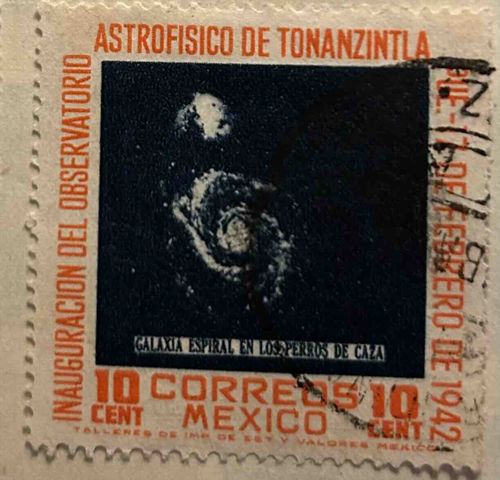
This item is a postage stamp from Mexico, likely issued in 1942, commemorating the inauguration of the Observatorio Astrofísico de Tonantzintla. The stamp is predominantly light brown or off-white with design elements in dark blue and orange-red. The central and largest portion of the design features a dark blue rectangular panel depicting a celestial image, specifically labeled as 'GALAXIA ESPIRAL EN LOS PERROS DE CAZA' (Spiral Galaxy in Canes Venatici), showcasing a detailed spiral galaxy. Above this panel, in orange-red text, is 'ASTROFISICO DE TONANZINTLA'. Vertically along the left edge, also in orange-red, it reads 'INAUGURACION DEL OBSERVATORIO'. The bottom portion of the stamp indicates its denomination: '10 CORREOS 10 CENT MEXICO CENT'. A smaller, very faint line of text below this likely indicates the printing house, possibly 'TALLERES DE IMP. DE EST. Y VALORES MEXICO'. A significant feature is the presence of a postal cancellation mark on the right side, oriented vertically, which clearly shows 'FEBRERO DE 1942', confirming its usage date. The stamp exhibits perforation along all four edges, indicating it was separated from a sheet. Visible condition issues include some light wear and discoloration consistent with its age and use, particularly an ink mark from the cancellation that partially obscures the text on the right side. The paper appears to have yellowed slightly over time. The overall appearance suggests a used, circulated stamp with historical significance related to Mexican astronomy.
AI Appraisal Report
I have examined the provided description of the Mexico 1942 Observatorio Astrofísico de Tonantzintla stamp. Based on this information, my appraisal value is $5 - $15. This stamp appears authentic for the period, consistent with Mexican postal issues of 1942, particularly its commemorative nature for the Tonantzintla observatory and the presence of a 1942 cancellation. The design elements, denomination, and indicated printing house align with known examples of this issue.
The condition, as described, is 'used, circulated' with 'light wear and discoloration' and a 'yellowed' appearance, which is typical for a stamp of this age. The cancellation mark, while confirming usage and date (February 1942), partially obscures text, which slightly detracts from its aesthetic appeal but confirms its postal history. Without a high-resolution image, it's impossible to discern subtle flaws like thins, creases, or repairs that would significantly impact value.
This particular stamp, Scott #C119, is not exceptionally rare. While historically significant, its market demand is moderate. Comparables typically sell in the single to low double-digit dollar range for used examples in average to fine condition. Factors impacting value are primarily the overall condition (centering, gum if unused, lack of hidden faults), and the clarity/neatness of the cancellation. A very light, neat cancellation would fetch a higher price, as would a pristine unused example.
It's important to note the limitations of this appraisal. While the description strongly suggests authenticity, a definitive verification requires physical inspection to examine paper type, watermarks (if applicable), printing methods, and gum (if unused) under magnification. This would also allow for a more precise assessment of any hidden faults that may not be apparent from a description.