AI Appraisal Estimate

AI-generated estimates · not official valuations

From the user

What was submitted

Photo and notes provided by the user — not generated by AI

Submitted item photo
Submitted photo · June 20, 2026

User's notes

No additional notes provided.

AI analysis below

AI appraisal

AI analysis & estimate

AI-Generated · Verify before acting

Everything below is generated by AI for informational purposes only. AI can make mistakes — the AI may misidentify items or misattribute them (artist, maker, brand, designer, origin, era). This is not an official valuation and should not be used for insurance, sale, tax, estate, legal, or lending purposes — or any decision requiring a certified appraisal. It is not an authoritative claim about any person, brand, or rights holder — do not share or rely on it as a factual statement about a third party. Always consult qualified professionals before making financial decisions.

Read the full disclaimer

AI Identification

·Not independently authenticated·Verify before acting

Tapestry Embroidery of a European Village Street Scene

Fine Art - Textiles & Needlework

AI Estimated Value

·Not an official valuation·Verify before acting

$45-75

As of June 20, 2026

AI Item Analysis

·AI can make mistakes·Verify before acting
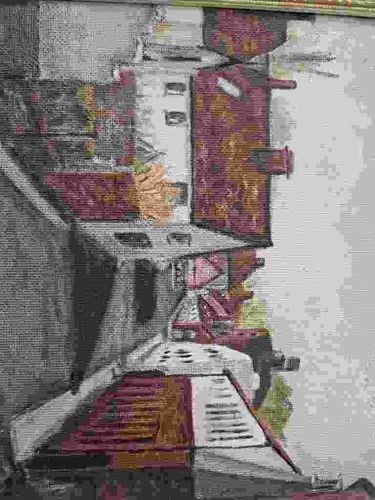
This item is a detailed fiber art piece, specifically a needlepoint or tapestry embroidery depicting a quaint European-style village street scene. The composition features several white-walled cottages with high-pitched, red or terracotta-tiled roofs, likely representing 18th or 19th-century architecture common in regions such as England or Germany. The color palette is dominated by rustic earthy tones, including deep reds, browns, and off-whites, contrasted against greenery in the background. The construction utilizes a variety of stitch patterns on a canvas or heavy fabric backing to create texture and depth, particularly visible in the tiled roofs and the gravel-like roadway. The piece shows signs of age with a gentle fading of the thread colors and some minor visible fraying at the edges. While no maker's mark or signature is clearly visible in the provided image, the craftsmanship suggests a skilled hand-made hobbyist piece from the mid-to-late 20th century. The quality of the stitching provides a 3D-like effect to the architecture, though some pixelation in the thread-work suggests it may have been created from a commercial pattern kit. The item is currently unframed, showing raw fabric borders.
AI Appraisal Report

·AI can make mistakes·Verify before acting
I have virtually examined this hand-stitched needlepoint depicting a European village. The piece displays a high level of technical competency, particularly in the structural depth achieved through varied stitch density in the rooflines and masonry. Based on the color palette and stylistic execution, I date this piece to the mid-to-late 20th century (c. 1960–1980). The condition appears fair to good; while the thread tension remains stable, there is noticeable fading from light exposure and raw, unfinished edges which suggests it was previously removed from a frame or never completed for display. The market for mid-century European-style needlepoint is currently saturated. These pieces were largely produced from mass-market commercial kits (such as those by Royal Paris or Elizabeth Bradley), which limits their rarity and investment value. Comparisons for similar unframed hobbyist works of this size typically realize between $30 and $90 at auction or through secondary craft markets. The value is primarily driven by the 'decorative appeal' and the labor involved rather than artistic provenance. A significant limitation of this digital appraisal is the inability to inspect the reverse side ('the verso'). An in-person examination is required to check for 'staining from the back,' which can indicate acidic damage from previous wooden backings, and to confirm the thread fiber (wool vs. synthetic). To elevate this to a professional 'Fine Art' category, provenance documentation linking it to a known textile artist or exhibition history would be necessary. Without a signature or maker's mark, it remains classified as a high-quality decorative folk-art piece.

Get your items appraised

Instant estimates of your treasures with AI-powered appraisals

Browse More Appraisals