AI estimate as of November 10, 2025 · verify with a professional before acting
AI-Generated · Verify before acting
Everything on this page is generated by AI for informational purposes only. AI can make mistakes — the AI may misidentify items or misattribute them (artist, maker, brand, designer, origin, era). This is not an official valuation and should not be used for insurance, sale, tax, estate, legal, or lending purposes — or any decision requiring a certified appraisal. It is not an authoritative claim about any person, brand, or rights holder — do not share or rely on it as a factual statement about a third party. Always consult qualified professionals before making financial decisions.
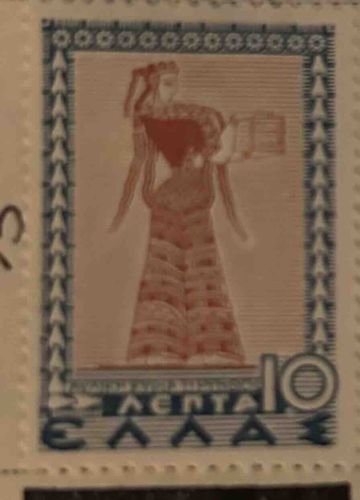
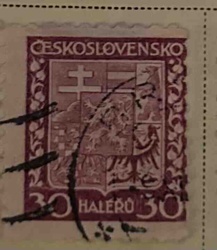
This item is a single, rectangular postage stamp, featuring a design centered around a classical female figure, specifically a Caryatid. The dominant colors visible are shades of red or terracotta for the figure and surrounding elements, contrasted with blue detailing in the borders and text, all set against a lighter, possibly off-white or cream background. The stamp displays perforation along all four edges, indicating it was separated from a sheet.
The central motif is a stylized depiction of a Caryatid, a sculptured female figure serving as an architectural support. She appears to be standing on a base, wearing a long, pleated or folded garment that extends to her feet. Her torso is accentuated by what looks like a V-shaped or heart-shaped upper garment in a deeper red tone. She is holding an object in her left arm, possibly a basket or a book, while her right arm hangs alongside her body, partially obscured. Her hair is styled upwards or in a bun.
Around the central image, the stamp features a decorative border. The inner border consists of a string of small circular or oval shapes at the top, and a repeating triangular or arrow-like pattern along the sides, rendered in blue. Below the Caryatid, there are Greek words 'ΛΕΠΤΑ' (LEPTA) and 'ΕΛΛΑΣ' (HELLAS), also in blue. To the right of the figure, the numeral '10' is prominently displayed, signifying the stamp's denomination.
The visible condition suggests some minor handling, given the slight blurring in parts of the image, but no obvious tears or significant creases are immediately apparent. The colors generally appear well-preserved. Based on the design, particularly the classical motif and the Greek text, it likely dates from the 20th century, possibly mid-century, reflecting a neoclassical or nationalistic artistic style common in Greek philately. The craftsmanship appears to be of standard postal stamp quality, achieved through a printing process that allows for fine lines and color separation.
AI Appraisal Report
After a thorough visual examination of the provided image of the Greek 10 Lepta postage stamp with the Caryatid design, I can offer the following appraisal. The stamp appears to be a common issue from Greece, likely from the early 20th century. My assessment of its condition, based solely on the image, is 'Very Fine' to 'Extremely Fine'. The centering is good, and the perforations appear intact. There are no obvious tears, creases, or major thins visible. The colors exhibit good preservation.
From the image, authenticity appears consistent with known examples of this issue. However, definitive authentication cannot be made without a physical inspection. Key aspects that would require in-person examination include watermark verification, paper type, printing method details, and examination under magnification for expertizing marks or potential repairs not visible in the image. Provenance documentation, while helpful, is often unavailable for common single stamps.
Market conditions for this particular stamp are generally stable but low. It is not considered rare. Comparables show similar examples in 'Very Fine' to 'Extremely Fine' condition typically selling in the $5-$15 range. Demand is moderate among general Greek stamp collectors. Factors impacting value positively include the good centering and apparent lack of major flaws. Conversely, its commonality means high demand for specimens in average condition is low. A higher value would only be achieved if it were part of a rare plate block, error variety, or had exceptional postal history.
Limitations: Without physical examination, I cannot conclusively verify the watermark, paper type, gum condition, or rule out subtle repairs. A physical inspection by an expertizer is highly recommended for full authentication.