AI estimate as of October 2, 2025 · verify with a professional before acting
AI-Generated · Verify before acting
Everything on this page is generated by AI for informational purposes only. AI can make mistakes — the AI may misidentify items or misattribute them (artist, maker, brand, designer, origin, era). This is not an official valuation and should not be used for insurance, sale, tax, estate, legal, or lending purposes — or any decision requiring a certified appraisal. It is not an authoritative claim about any person, brand, or rights holder — do not share or rely on it as a factual statement about a third party. Always consult qualified professionals before making financial decisions.
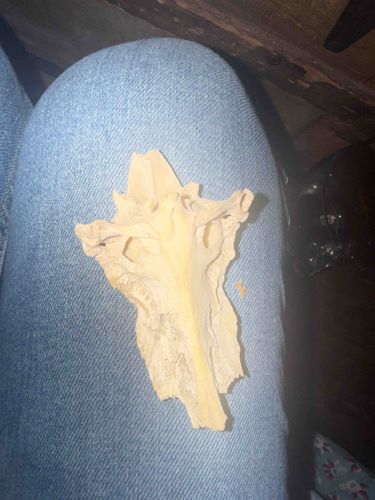
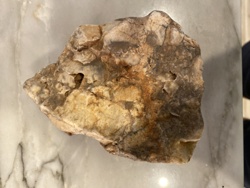
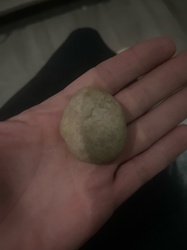
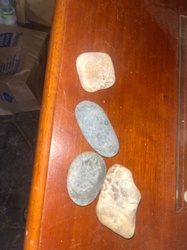
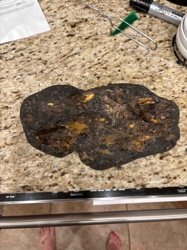
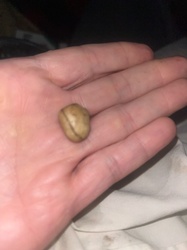
The item appears to be a weathered bone fragment, possibly from a larger animal, resting on a person's denim-clad knee. The fragment is irregularly shaped, elongated along one axis with a central ridge or spine visible, and protrusions extending outwards from its sides, suggesting it might be part of a larger skeletal structure like a vertebra or a cranial element. Its color is a uniform, aged cream to light tan, indicating significant exposure to the elements or natural decay over time. The texture appears porous and somewhat chalky, characteristic of dried and denatured bone. The edges are rough and irregular, with some areas showing signs of chipping and natural erosion, rather than clean breaks from an intentional cut. There are no discernible markings, inscriptions, or polished surfaces to suggest artificial modification or artistic intent. The overall condition suggests it is a natural specimen, possibly found outdoors, with a natural patina of age and weathering. The visible craftsmanship is that of nature's processes, with no human intervention apparent. It's difficult to ascertain its exact size without scale, but it appears to be several inches in length. Its estimated age is indeterminate without further analysis, but its weathered look suggests it is not a recent specimen. Unique aspects include its complex, anatomical-like structure, which hints at its biological origin. The quality indicators are in its natural preservation and the degree of weathering.
AI Appraisal Report
Based on my visual examination of the provided image, this weathered bone fragment appears to be a natural specimen, likely from a medium to large animal. Its irregular shape, central ridge, and protrusions suggest it could be a piece of a vertebra or other complex bone structure. The uniform cream-to-tan color, porous texture, and rough, chipped edges are consistent with significant exposure to natural elements and decay, indicating it is not a recent specimen. There are no signs of human modification, such as carvings, inscriptions, or polishing, suggesting it is a natural find rather than an artifact.
In terms of market conditions, natural bone fragments, unless they possess significant scientific, historical, or cultural provenance (e.g., fossilized, associated with a rare species, or found at an archaeological site), generally have very limited commercial value. Comparables would be other found bone fragments, often sold as curiosity items or for crafting. Demand for such an item is low, and it is not inherently rare. The primary factor impacting its value is its natural origin and the lack of any unique identifying features or context.
However, it is crucial to note the limitations of appraising from an image alone. While its general appearance suggests it is bone, physical inspection would be required to definitively confirm its composition and rule out other materials. Without provenance documentation (e.g., where and when it was found, by whom), its exact age and origin are speculative. Scientific testing, such as radiometric dating or DNA analysis, would be necessary to determine its precise age, species of origin, and potential paleontological significance. Without such information, its authenticity as a significant specimen cannot be fully verified, and its value remains minimal, primarily as a natural curiosity.