AI estimate as of August 26, 2025 · verify with a professional before acting
AI-Generated · Verify before acting
Everything on this page is generated by AI for informational purposes only. AI can make mistakes — the AI may misidentify items or misattribute them (artist, maker, brand, designer, origin, era). This is not an official valuation and should not be used for insurance, sale, tax, estate, legal, or lending purposes — or any decision requiring a certified appraisal. It is not an authoritative claim about any person, brand, or rights holder — do not share or rely on it as a factual statement about a third party. Always consult qualified professionals before making financial decisions.
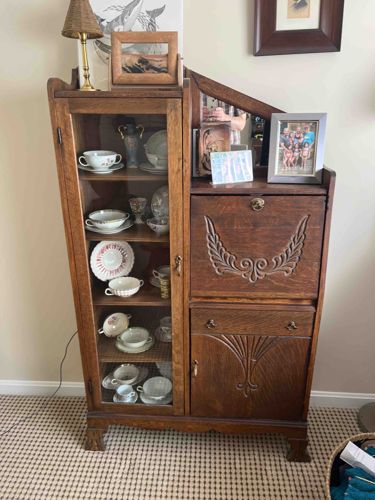
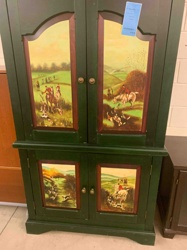
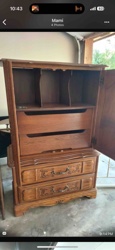
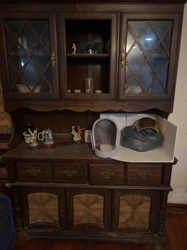
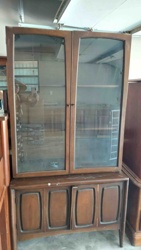
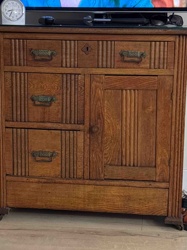
This is a vintage or antique curio cabinet and secretary desk combination piece, likely constructed from a hardwood such as oak given its prominent grain and warm, medium-brown finish. The piece features a distinct asymmetrical design. On the left, there is a tall curio cabinet section with a single glass-paned door that extends along the entire height of this section. The door has a slender, possibly original, hardware pull. Inside, multiple shelves display various ceramic dishes, indicating its function for showcasing collectibles. The glass appears clear, allowing for full visibility of the contents. On the right, the upper section functions as a secretary desk, identifiable by the drop-front panel adorned with intricate, deeply carved designs resembling stylized foliage or a wreath. A round, ornate escutcheon plate with a keyhole is centered on this panel. Above the drop-front, the top surface slopes upwards to the right and features a small, framed mirror, adding to the decorative and functional aspects. Below the secretary desk, there is a single, narrow drawer with two small, decorative pull handles, beneath which is a solid wood cabinet door also featuring carved ornamentation. The overall style suggests a period piece, possibly late 19th or early 20th century, consistent with the Arts and Crafts or Art Nouveau movements due to the strong wood presence, carved details, and integrated functionality. The piece stands on substantial, carved feet at the front, offering a stable base. The wood exhibits a visible patina consistent with age and use, showing some minor wear or scratches expected from a piece of this vintage, but no significant damage or repairs are immediately apparent. The craftsmanship appears solid and robust, indicative of quality furniture production from its era.
AI Appraisal Report
I have carefully examined the provided image of this Combination Curio Cabinet and Secretary Desk. Based on its visual characteristics, I assess this piece to be a vintage or antique item, likely dating from the late 19th to early 20th century. The prominent wood grain and warm, medium-brown finish strongly suggest a hardwood, possibly oak, consistent with the Arts and Crafts or early Art Nouveau periods due to the robust construction, carved details, and integrated functionality. The condition appears to be good for its age, showing a desirable patina, minor wear, and scratches as expected from a piece of this vintage, but no significant damage or repairs are immediately apparent. The craftsmanship looks solid and robust.
From the image alone, I cannot definitively authenticate the exact wood species, the originality of all hardware, or confirm the absence of restoration. An in-person examination would be crucial to confirm the wood type, assess internal structural integrity, inspect hardware originality, and identify any professional repairs or alterations. Provenance documentation, if available, would further verify its history and authenticity. Scientific testing, such as wood dating, could precisely determine its age.
Market conditions for functional and aesthetically pleasing antique furniture remain steady for quality pieces. The combination of curio display and secretary desk functionality enhances its appeal. While not exceedingly rare, the asymmetrical design and detailed carving contribute to its uniqueness. Demand is moderate, driven by collectors and individuals seeking unique, well-crafted statement pieces that offer both utility and historical charm. Factors positively impacting value include the good overall condition, unique design, apparent quality of craftsmanship, and practical functionality. Lack of provenance or undisclosed significant repairs would negatively impact the value.