AI estimate as of July 26, 2025 · verify with a professional before acting
AI-Generated · Verify before acting
Everything on this page is generated by AI for informational purposes only. AI can make mistakes — the AI may misidentify items or misattribute them (artist, maker, brand, designer, origin, era). This is not an official valuation and should not be used for insurance, sale, tax, estate, legal, or lending purposes — or any decision requiring a certified appraisal. It is not an authoritative claim about any person, brand, or rights holder — do not share or rely on it as a factual statement about a third party. Always consult qualified professionals before making financial decisions.
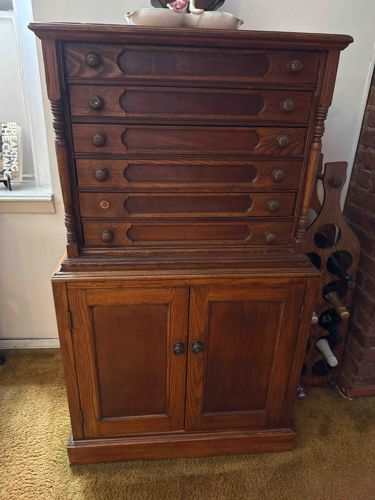
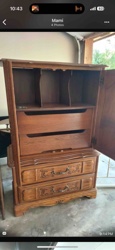
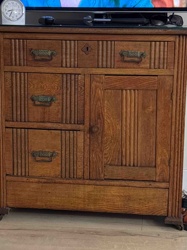
This is a freestanding wooden cabinet, likely constructed from a hardwood such as oak, given its visible grain pattern and rich, reddish-brown stain. The piece is composed of two primary sections: an upper chest of drawers and a lower two-door cabinet base. The overall style suggests an early 20th-century aesthetic, possibly aligning with Mission Revival or Arts and Crafts influences due to its robust construction and simple, yet decorative, elements.
The upper section features five drawers, each adorned with a carved or routed decorative panel in the center, giving them a distinct and uniform appearance. The drawer pulls are round, possibly made of brass or a similar metal, and appear to have a patinated finish consistent with age. One pull on the second-to-last drawer from the top seems to be missing its central pin or attachment, leaving a visible hole, indicating minor wear or damage. The top of the upper unit has a flat surface with a slight overhang, suitable for display. Flanking the drawers on either side are decorative vertical pilasters with carved or turned detailing, adding to its visual appeal and structural reinforcement.
The lower section consists of a two-door cabinet with raised panel doors. These doors are fitted with matching round metal pulls, though slightly larger than those on the drawers, and appear to be in good condition. The base of the entire unit is a solid plinth-style base, elevating the cabinet slightly from the floor. The wood exhibits a uniform finish throughout, with some minor signs of wear and tear, such as surface scratches or slight fading expected from a piece of this age. The construction appears solid and well-crafted, with visible joints suggesting traditional carpentry techniques. No distinct maker's marks or signatures are immediately visible in the provided image.
AI Appraisal Report
I have examined the provided image of this Multi-Drawer Cabinet with Base Storage. Based on its visible characteristics, I assess it to be a freestanding wooden cabinet, likely crafted from oak, exhibiting a reddish-brown stain. The design, particularly the robust construction, decorative carved panels, and round metal pulls, strongly suggests an early 20th-century origin, consistent with Mission Revival or Arts and Crafts styles.
The condition appears good for its age. The wood exhibits a uniform finish with expected minor wear, such as surface scratches or slight fading. The primary visible issue is a missing central pin or attachment on one drawer pull, leaving a small hole. Otherwise, all other pulls and components appear intact. Authenticity, based solely on this image, seems plausible for the described period and style, given the traditional joinery suggested by visible construction details.
In terms of market conditions, pieces from the Arts and Crafts and Mission Revival movements generally retain a steady, moderate demand, particularly those with functional storage and appealing design. Comparable pieces in good condition often fetch prices reflecting their age, craftsmanship, and utility. This piece offers both aesthetic appeal and practical storage capacity.
Factors impacting value include its good overall condition, period-appropriate styling, and functional design. The minor damage to one drawer pull is easily rectifiable and does not significantly detract from its value. While likely not rare, good quality, well-preserved examples like this are always sought after.
It is crucial to note that this appraisal is based purely on visual examination of the provided image. Limitations in authenticity verification from images alone are significant. A full in-person examination would be necessary to confirm wood species, construction integrity, assess internal condition of drawers, identify any hidden repairs or restorations, and search for faint maker's marks not visible in the image. Provenance documentation, if available, would further solidify its history and authenticity. Scientific testing, such as wood dating, could provide definitive age confirmation if doubts arose, though not typically necessary for pieces of this presumed age and style.