AI Appraisal Estimate

AI-generated estimates · not official valuations

From the user

What was submitted

Photo and notes provided by the user — not generated by AI

Submitted item photo
Submitted photo · June 11, 2026

User's notes

No additional notes provided.

AI analysis below

AI appraisal

AI analysis & estimate

AI-Generated · Verify before acting

Everything below is generated by AI for informational purposes only. AI can make mistakes — the AI may misidentify items or misattribute them (artist, maker, brand, designer, origin, era). This is not an official valuation and should not be used for insurance, sale, tax, estate, legal, or lending purposes — or any decision requiring a certified appraisal. It is not an authoritative claim about any person, brand, or rights holder — do not share or rely on it as a factual statement about a third party. Always consult qualified professionals before making financial decisions.

Read the full disclaimer

AI Identification

·Not independently authenticated·Verify before acting

Live Edge Hardwood Burl Slabs

Raw Materials / Woodworking Supplies

AI Estimated Value

·Not an official valuation·Verify before acting

$1,200 - $1,850

As of June 11, 2026

AI Item Analysis

·AI can make mistakes·Verify before acting
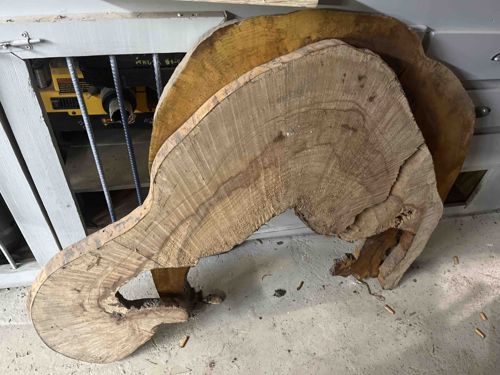
This item consists of two matching live edge hardwood slabs, likely cross-cuts from a large tree burl or a root flare section. The primary slab in the foreground exhibits a highly irregular, organic shape with a prominent void/hole and a curved 'arm' extending outward. The thickness appears to be approximately 2 to 3 inches. The wood grain is incredibly dense and complex, showing characteristic burl swirling, bird's-eye patterns, and erratic growth rings. The color transition ranges from a light pale cream to deep amber and honey tones. The edges are 'live' or natural, retaining the original contour of the tree's exterior. In terms of condition, these are unfinished raw materials. There is visible surface checking (small cracks), particularly near the void, which is common in large cross-sections. Some sawdust and light surface debris are present, indicating they have recently been processed or stored in a workshop environment. There are no visible maker's marks, as these are raw wood stock. These slabs are likely intended for use as high-end furniture components, such as a coffee table top or artistic wall hanging. The size and complexity of the grain suggest they are from a slow-growing hardwood species, potentially Ash, Oak, or Maple, and are estimated to be contemporary cuts.
AI Appraisal Report

·AI can make mistakes·Verify before acting
I have conducted a visual examination of these two matching live edge hardwood burl slabs. Based on the complex grain density, swirling 'bird's-eye' patterns, and the amber-to-cream coloration, these specimens appear to be high-quality cross-cuts from a significant burl or root flare, likely of the Maple or Oak genus. The primary piece is particularly desirable due to its unique skeletal geometry and central void, which is currently a high-demand aesthetic in the custom furniture market for 'river table' or epoxy-resin applications. The slabs appear to be air-dried or kiln-dried raw stock with a substantial thickness of 2-3 inches, providing the structural integrity needed for high-end furniture. While I observed some minor surface checking and radial cracks near the void, these are standard for burls of this size and do not significantly detract from the value, as they are often filled or stabilized during the finishing process. The market for book-matched or matching sets of this figure is currently robust, with custom woodworkers and interior designers paying premiums for slabs that exhibit this level of natural character. Limitations: This appraisal is based strictly on visual photographic evidence. I cannot definitively verify the species or internal moisture content without an in-person inspection using a moisture meter. Full authentication would require physical measurement of dimensions to determine board-footage and a tactile assessment for soft spots or hidden rot. Knowledge of the drying method (kiln vs. air) and provenance (geographic origin) would further refine the valuation. Without physical inspection, the species identification remains a professional estimate based on visual grain markers.

Get your items appraised

Instant estimates of your treasures with AI-powered appraisals

Browse More Appraisals