AI estimate as of August 25, 2025 · verify with a professional before acting
AI-Generated · Verify before acting
Everything on this page is generated by AI for informational purposes only. AI can make mistakes — the AI may misidentify items or misattribute them (artist, maker, brand, designer, origin, era). This is not an official valuation and should not be used for insurance, sale, tax, estate, legal, or lending purposes — or any decision requiring a certified appraisal. It is not an authoritative claim about any person, brand, or rights holder — do not share or rely on it as a factual statement about a third party. Always consult qualified professionals before making financial decisions.
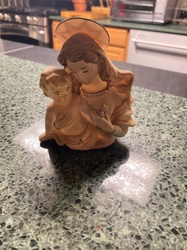
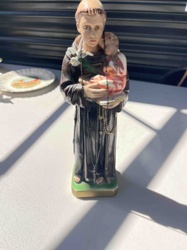
This is a hand-carved and painted wooden figurine depicting the Madonna and Child, likely of European origin, possibly Alpine or Italian due to the carving style and color palette. The Madonna, a central figure in Christian art, is shown holding the infant Jesus in her arms. She is depicted standing, with her gaze gently directed towards the child. Her head is slightly tilted, conveying a sense of motherly tenderness and devotion. The figure's attire consists of a flowing gown, primarily painted in an off-white or cream color, with accents of a dark green or teal cloak draped over her shoulders and arms, and a golden-yellow or ochre trim. The drapery is sculpted with soft folds, suggesting the movement and texture of fabric. The skin tones of both figures are naturalistic, with subtle rosy cheeks for the infant. The base of the figurine appears to be an integral part of the carving, featuring a crescent moon with visible stars, which is a common iconographic element associated with the Immaculate Conception or Our Lady of Guadalupe. The carving exhibits good craftsmanship, with smooth finishes and attention to detail in the facial features and hands. There are no obvious signs of significant damage like cracks or chips; however, given its likely age and material, minor wear to the painted surfaces or a light patina might be present upon closer inspection. The overall condition appears to be relatively good, suggesting it has been well-preserved. The style points to a traditional religious art piece, possibly from the mid-20th century or earlier, emphasizing devotional aesthetics.
AI Appraisal Report
Based on my visual examination of the provided image of this Madonna and Child wooden carving, I assess its condition as good. The painted surfaces appear largely intact with no obvious significant chips or losses, and the carving exhibits a smooth finish with detailed facial features, indicating good craftsmanship. The presence of a crescent moon base with stars is a classic iconographic element, adding to its devotional appeal.
From the image alone, authenticity regarding age and origin is difficult to definitively confirm. The style suggests European, possibly Alpine or Italian, dating from the mid-20th century or earlier. However, without physical inspection, I cannot verify the wood type, the exact age of the paint layers, or detect subtle repairs or restorations. Market conditions for traditional religious folk art, particularly well-preserved devotional pieces, remain steady. Comparables for hand-carved Madonna and Child figures of similar presumed age and quality typically range from a few hundred to over a thousand dollars, depending heavily on provenance, condition, and artistic merit. Demand exists within collectors of religious art and devotional items.
The primary limiting factor in this appraisal is the lack of physical examination. An in-person inspection would allow for tactile assessment to confirm the wood species, detect any minor surface wear or patina not visible in images, and thoroughly scrutinize paint layers for originality and age. Provenance documentation, such as records of acquisition or a history of ownership, would significantly enhance authentication and value. Scientific testing, like carbon dating for the wood if sufficient age is suspected, or pigment analysis, would be necessary for a full and irrefutable authentication.