These notes were written by the person who submitted this item. Appraiser.AI has not verified them, and the AI's identification and estimate may rely on them.
AI Estimated Value
Not an official valuation
$10 - $20
AI estimate as of September 8, 2025 · verify with a professional before acting
AI-Generated · Verify before acting
Everything on this page is generated by AI for informational purposes only. AI can make mistakes — the AI may misidentify items or misattribute them (artist, maker, brand, designer, origin, era). This is not an official valuation and should not be used for insurance, sale, tax, estate, legal, or lending purposes — or any decision requiring a certified appraisal. It is not an authoritative claim about any person, brand, or rights holder — do not share or rely on it as a factual statement about a third party. Always consult qualified professionals before making financial decisions.
This analysis also relies on unverified notes provided by the user, which may be incomplete or inaccurate and could affect the result.
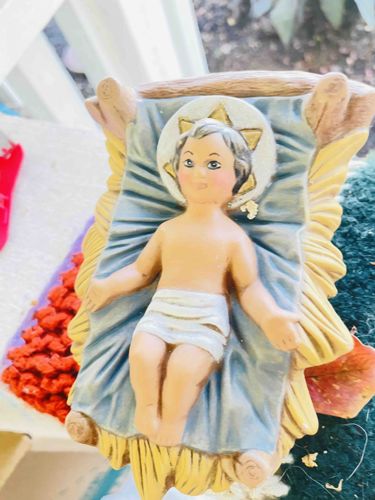
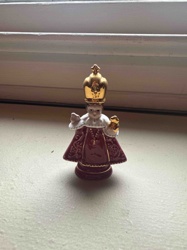
This item is a decorative figurine depicting the infant Baby Jesus lying in a manger. It appears to be constructed from a ceramic or resin material, likely cast from a mold and then hand-painted. The color palette primarily includes muted tones: a flesh tone for the baby, light brown and tan for the manger, and a soft blue for the swaddling or blanket. The physical characteristics show a relatively small, compact piece designed for display, likely as part of a Christmas nativity set. The baby figure is depicted with chubby limbs, a round face, and light brown hair. Notable features include the gold-colored halo with a six-pointed star radiating around the baby's head, indicating its religious significance. The manger is textured to resemble straw, and the blue blanket beneath the baby has sculpted folds, suggesting detail in its construction. There is a visible chip or damaged area on the right side of the halo, near the baby's temple, which appears to have exposed the base material underneath. This is a clear condition issue. The craftsmanship is indicative of mass-produced decorative items, with painted facial features that are somewhat idealized but not highly realistic. There are no visible maker's marks or signatures in the provided image. Based on its style and common production methods for holiday decor, this item likely dates from the late 20th to early 21st century. It exhibits a somewhat naive, folk-art inspired aesthetic, common in many commercially available Christmas decorations.
AI Appraisal Report
Based on my visual examination of the provided image, this Baby Jesus in Manger figurine appears to be a mass-produced decorative item, likely crafted from ceramic or resin. The overall condition shows a significant flaw: a visible chip on the right side of the gold-colored halo, which impacts its aesthetic appeal and value. Wear and tear consistent with display are also present. The craftsmanship, while detailed in areas like the textured manger and sculpted folds of the blanket, is typical of commercially available holiday decor rather than a fine art piece. The painted features are stylized, indicating a factory finish.
Market conditions for such items are generally stable but with low values. Comparables include similar resin or ceramic nativity figurines widely available from retailers, often sold as part of larger sets or as individual components. There is a consistent demand for religious figurines, particularly around the Christmas season, but the supply of mass-produced items is high, making them neither rare nor highly sought-after collector's items. The primary factors impacting value for this specific piece are its mass-produced nature, common design, and the noted damage, which significantly reduces its market desirability. Without the damage, it would still fall into a similar low-value range.
Regarding authenticity, from images alone, I can only assess its visual characteristics. There are no visible maker's marks or signatures, which is common for this type of item, making precise attribution or dating challenging without an in-person inspection. For full authentication of material composition or to identify potential manufacturers, a physical examination would be necessary to assess the material properties firsthand (e.g., density, surface feel) and to search for any faint marks not visible in the photo. Provenance documentation (e.g., original packaging, purchase receipts) could also aid in verification, though this is rare for such common decorative items. Given its likely modern production, scientific testing for material dating would generally not be economically viable or necessary.