AI Appraisal Estimate

AI-generated estimates · not official valuations

From the user

What was submitted

Photo and notes provided by the user — not generated by AI

Submitted item photo
Submitted photo · June 20, 2026

User's notes

No additional notes provided.

AI analysis below

AI appraisal

AI analysis & estimate

AI-Generated · Verify before acting

Everything below is generated by AI for informational purposes only. AI can make mistakes — the AI may misidentify items or misattribute them (artist, maker, brand, designer, origin, era). This is not an official valuation and should not be used for insurance, sale, tax, estate, legal, or lending purposes — or any decision requiring a certified appraisal. It is not an authoritative claim about any person, brand, or rights holder — do not share or rely on it as a factual statement about a third party. Always consult qualified professionals before making financial decisions.

Read the full disclaimer

AI Identification

·Not independently authenticated·Verify before acting

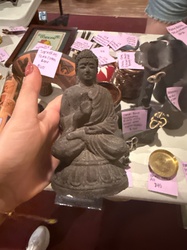
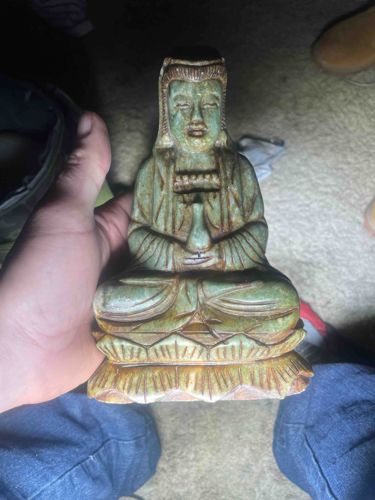
Seated Guanyin (Avalokiteshvara) Figure

Asian Art & Religious Statuary

AI Estimated Value

·Not an official valuation·Verify before acting

$150 - $250

As of June 20, 2026

AI Item Analysis

·AI can make mistakes·Verify before acting
This is a hand-carved stone statuette depicting the bodhisattva Guanyin, known as the Goddess of Mercy. The figure is shown seated in a dhyana asana (meditation pose) on a double-layer lotus pedestal. Measuring approximately 6 to 8 inches in height, the piece is carved from a heavy, dense stone, likely soapstone or a low-grade jadeite, characterized by a variegated celadon-green and earth-toned brown color palette. Guanyin is rendered with traditional iconography, including flowing robes with deep rhythmic folds, a serene expression with downcast eyes, and high-piled hair covered by a cowl. She holds a 'pure water' vase (kalasha) in her lap, a classic attribute symbolizing the nectar of compassion. The craftsmanship shows a mix of fluid carving in the drapery and more stylized, geometric execution in the lotus base. Condition-wise, the piece shows significant surface patina and localized grime within the recessed carvings, which is typical for items of some age or those handled frequently. There are minor abrasions and small chips visible along the sharp edges of the lotus petals and the base, suggesting it may be a mid-20th-century decorative piece or a later export-style carving in the traditional Qing manner. The material's natural inclusions and veining are prominent, especially on the face and chest, contributing to its organic aesthetic. No distinct maker's marks or signatures are visible in the provided view.
AI Appraisal Report

·AI can make mistakes·Verify before acting
I have examined the provided imagery of the Seated Guanyin figure. The statuette exhibits characteristics consistent with mid-20th-century Chinese export carvings, likely executed in soapstone or a similar softstone composite. The 'dhyana asana' posture and lotus base are rendered with fair skill; however, the lack of refined undercutting and the presence of simplified, geometric patterns on the pedestal suggest a decorative rather than liturgical origin. The variegated coloration appears natural to the stone, though the surface grime and patina are typical of household display rather than centuries of ritual use. The minor chipping on the lotus petals is a common condition issue for stone of this density and affects the value nominally as a decorative object. The market for mid-century export art is currently stable but saturated, with high supply and moderate demand. Comparables sold at regional auctions for similar 'Republic period' style carvings generally fall within the $100 to $300 range depending on size and stone quality. The most significant factor limiting this piece's value is the material; if the stone were high-grade nephrite or jadeite, the value would increase exponentially. It is important to note that a definitive assessment of the material composition and internal structural integrity cannot be made through images alone. A full authentication would require a physical refractive index test to identify the mineral species, a thorough cleaning to inspect for hidden repairs or structural cracks, and a review of provenance documentation to verify the item’s age. Without these steps, the piece is valued primarily as a high-quality decorative vintage carving.

Get your items appraised

Instant estimates of your treasures with AI-powered appraisals

Browse More Appraisals