AI Appraisal Estimate

AI-generated estimates · not official valuations

From the user

What was submitted

Photo and notes provided by the user — not generated by AI

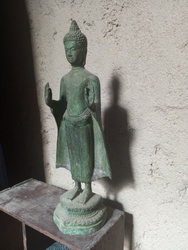
Submitted item photo
Submitted photo · June 13, 2026

User's notes

This is 5' tall and 17" across. Believed to be from China

AI analysis below

AI appraisal

AI analysis & estimate

AI-Generated · Verify before acting

Everything below is generated by AI for informational purposes only. AI can make mistakes — the AI may misidentify items or misattribute them (artist, maker, brand, designer, origin, era). This is not an official valuation and should not be used for insurance, sale, tax, estate, legal, or lending purposes — or any decision requiring a certified appraisal. It is not an authoritative claim about any person, brand, or rights holder — do not share or rely on it as a factual statement about a third party. Always consult qualified professionals before making financial decisions.

Note

This analysis also relies on unverified notes provided by the user, which may be incomplete or inaccurate and could affect the result.

Read the full disclaimer

AI Identification

·Not independently authenticated·Verify before acting

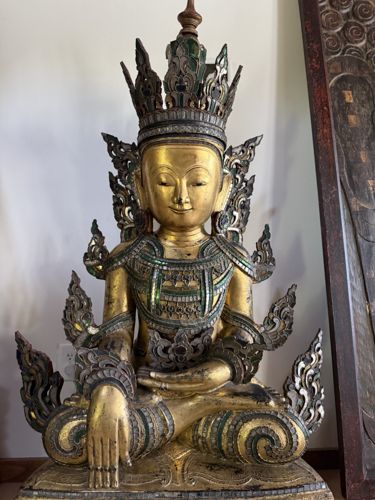
Thai-Burmese Style Crowned Gilded Wood Buddha

Asian Antiques & Religious Statuary

AI Estimated Value

·Not an official valuation·Verify before acting

$4,000 - $6,500

As of June 13, 2026

AI Item Analysis

·AI can make mistakes·Verify before acting
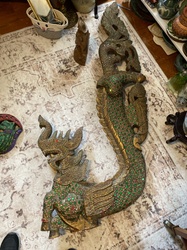
This is a life-sized, approximately 5-foot tall, 17-inch wide wooden Buddha statue, likely originating from Southeast Asia, specifically Thailand or Burma (Myanmar), in the Mandalay or Shan tradition rather than China. The figure is seated in the padmasana (lotus) position with one hand resting in the bhumisparsha mudra (earth-witness gesture). The statue is constructed from carved wood with a heavily gilded (gold leaf) finish and is adorned with 'hman-zi shwe-cha' glass mosaic inlay (thayo lacquer work) in shades of green and clear glass along the crown, collar, and robes. The figure features a characteristic high, tiered 'salwe' or royal crown and wing-like ear ornaments. Notable condition issues include visible wear to the gilding, particularly on the knees and face, showing the dark red lacquer primer beneath. There is evidence of dust accumulation in the crevices and potential minor losses to the glass mosaic fragments. The craftsmanship is intricate, showcasing the high-quality woodcarving and decorative glasswork typical of 19th or early 20th-century religious statuary. The serene facial expression, downcast eyes, and elongated earlobes are hallmarks of classical Buddhist iconography.
AI Appraisal Report

·AI can make mistakes·Verify before acting
Upon examination of this 5-foot-tall Gilded Wood Buddha, I have identified it as a significant example of Burmese ‘Jambupati’ or Kingly style statuary, likely from the late Mandalay period (late 19th to early 20th century). While the owner suggested a Chinese origin, the 'salwe' (royal chest decoration), tiered 'ushnisha' (crown), and 'thayo' (lacquer relief) glass mosaic work are definitive characteristics of Southeast Asian/Burmese craftsmanship rather than Chinese. The life-sized scale of 60 inches makes this a rare architectural or temple-grade piece, which significantly increases its marketability to high-end designers and religious art collectors. The condition shows authentic age-related wear; the 'red-hole' or 'bole' lacquer appearing through the gilding is a positive indicator of traditional construction rather than a modern reproduction. However, the visible losses in the glass inlay and the minor cracking in the wood base moderately affect the value. Current market demand for large-scale, serene Southeast Asian figures remains steady, with similar high-quality Mandalay figures reaching the mid-four-digit range at auction. Limitations: This appraisal is based on photographic evidence only. In-person physical inspection is required to verify if the core is a single piece of teak or joined, which impacts structural longevity. Furthermore, a scientific examination of the lacquer layers (scanning for modern synthetic binders) and documentation of provenance (history of ownership/import) would be necessary to confirm the exact age and ensure the piece was not illegally exported under modern cultural heritage laws. Without a carbon-14 test of the wood or microscopic analysis of the gilding, this valuation assumes a late 19th-century origin based on stylistic conventions.

Get your items appraised

Instant estimates of your treasures with AI-powered appraisals

Browse More Appraisals