AI estimate as of November 9, 2025 · verify with a professional before acting
AI-Generated · Verify before acting
Everything on this page is generated by AI for informational purposes only. AI can make mistakes — the AI may misidentify items or misattribute them (artist, maker, brand, designer, origin, era). This is not an official valuation and should not be used for insurance, sale, tax, estate, legal, or lending purposes — or any decision requiring a certified appraisal. It is not an authoritative claim about any person, brand, or rights holder — do not share or rely on it as a factual statement about a third party. Always consult qualified professionals before making financial decisions.
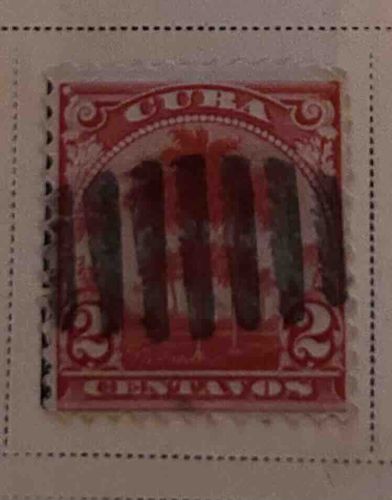
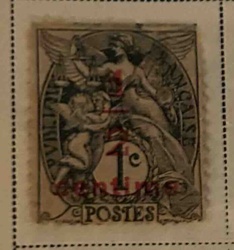
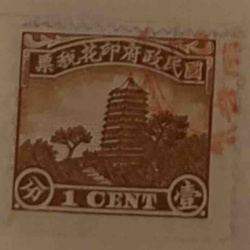
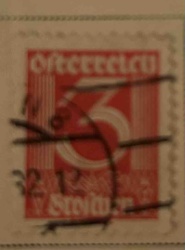
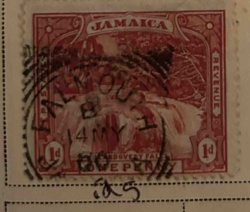
This item is a Cuban revenue stamp, specifically denominated for 2 Centavos. The stamp features a rectangular shape with serrated or perforated edges, indicating it was part of a larger sheet. The primary color of the stamp appears to be a muted red or dark pink, with design elements rendered in white or a lighter shade of the base color. At the top of the stamp, within an arched banner, the word "CUBA" is prominently displayed. Below this banner, the central design is somewhat obscured by four thick, vertical, dark overprints, which appear to be cancellation marks or a form of revalidation. Despite the overprints, faint details of a scenic image can be discerned, possibly depicting palm trees or a similar landscape, characteristic of Cuban imagery. The denomination '2' is visible in the lower left corner, and the word 'CENTAVOS' is clearly readable along the bottom edge, also within a banner or decorative frame. The stamp exhibits signs of age and use, including the aforementioned overprints. The perforations around the edges appear intact, though minor wear might be present upon closer inspection. The overall condition suggests that it is a used stamp, likely originating from the early to mid-20th century given the style and currency. The design elements showcase a typical revenue stamp aesthetic with decorative borders and clear text for country and denomination, emphasizing its fiscal purpose rather than postal. The quality of printing seems standard for the period.
AI Appraisal Report
I have examined the provided image of the Cuban 2 Centavos Revenue Stamp. Based on the visual evidence, it appears to be an authentic revenue stamp from Cuba, likely from the early to mid-20th century. The design, including the 'CUBA' inscription, '2 CENTAVOS' denomination, and what appears to be a landscape with palm trees, aligns with known Cuban revenue issues.
The stamp's condition is fair to good despite the prominent overprints, which I assess as cancellation marks or revalidation. While these overprints obscure parts of the central design, they are typical for used revenue stamps and do not necessarily diminish authenticity, though they can affect aesthetic appeal. The perforations appear intact, and the color seems consistent with known issues of this denomination.
Market conditions for common Cuban revenue stamps, especially used ones with cancellation marks, are generally modest. While Cuban philately has a dedicated collector base, 2 Centavos denominations are not usually considered rare unless they possess unique errors, varieties, or exceptional condition, which are not apparent here. Comparable sales of similar used common Cuban revenue stamps typically range from a few dollars to fifteen dollars, depending on the exact issue, shade, and specific cancellation.
Factors impacting value for this specific stamp include the legibility of the overprints and the clarity of the underlying design. The fact that it is a used stamp, as indicated by the overprints, places it in a different category than mint, never-hinged examples.
It is imperative to state that this appraisal is based solely on the provided image. Limitations in authenticity verification from images alone are significant. A full in-person examination would be crucial to confirm paper type, watermarks (if any), printing method specifics, gum condition (if applicable to a never-hinged state), and to thoroughly inspect for repairs, thins, or other hidden flaws that could impact value. Provenance documentation, if available, would also aid in verifying its history and authenticity. Scientific testing, such as spectroscopy for ink analysis, is typically reserved for high-value or questionable items, which this stamp does not appear to be within that category currently.