These notes were written by the person who submitted this item. Appraiser.AI has not verified them, and the AI's identification and estimate may rely on them.
AI Estimated Value
Not an official valuation
$150-250
AI estimate as of September 22, 2025 · verify with a professional before acting
AI-Generated · Verify before acting
Everything on this page is generated by AI for informational purposes only. AI can make mistakes — the AI may misidentify items or misattribute them (artist, maker, brand, designer, origin, era). This is not an official valuation and should not be used for insurance, sale, tax, estate, legal, or lending purposes — or any decision requiring a certified appraisal. It is not an authoritative claim about any person, brand, or rights holder — do not share or rely on it as a factual statement about a third party. Always consult qualified professionals before making financial decisions.
This analysis also relies on unverified notes provided by the user, which may be incomplete or inaccurate and could affect the result.
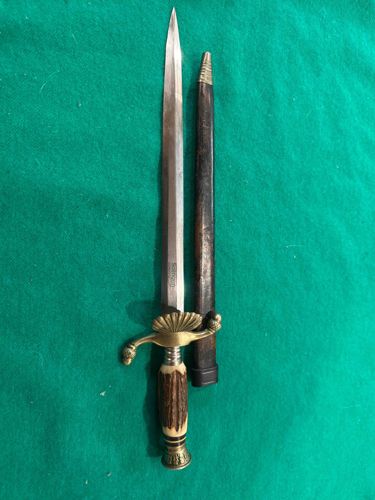
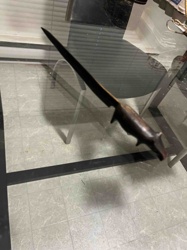
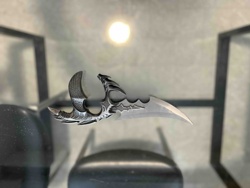
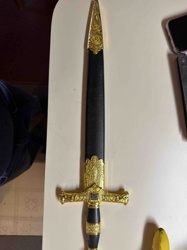
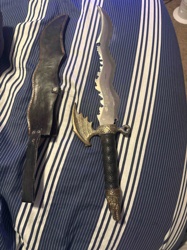
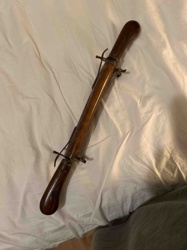
This item is a hunting dagger, likely from Solingen, Germany, as indicated by the visible marking on the blade. It features a sturdy, double-edged blade with a distinct central ridge, tapering to a sharp point. The blade exhibits a polished, metallic finish, consistent with steel, and shows some signs of age and possibly light surface corrosion or tarnishing, which is common for older metal items. The hilt is particularly ornate, displaying a brass or bronze-toned guard with a stylized shell or fan-like design at its center, flanked by scrolling quillions that terminate in spherical finials. The grip is crafted from what appears to be natural stag horn, characterized by its textured, bone-like appearance and natural coloration, ranging from light cream to darker brown. This material offers both an aesthetic appeal and a secure grip. The pommel is also made of the same brassy metal, with an intricate, possibly fluted or engraved design, adding to the dagger's decorative quality. Accompanying the dagger is a dark-colored scabbard, seemingly made of wood or leather, which has a simple, dark finish and a metallic-capped tip that appears to be brass or a similar alloy, consistent with the hilt's metalwork. The overall condition suggests a vintage piece with some wear commensurate with age, but no apparent major damage or repairs. The craftsmanship, particularly of the hilt and handle, indicates a quality manufacturing process typical of Solingen blades, often associated with fine edged weapons and cutlery.
AI Appraisal Report
Upon visual examination of the images provided, I have assessed this Solingen Stag Handle Hunting Dagger. The piece appears to be a genuine mid-to-late 20th-century German hunting or 'hirschfänger' style dagger, consistent with the quality craftsmanship associated with Solingen makers. The stag horn grip is well-formed and intact, and the brass/alloy fittings, including the shell guard and pommel, show a desirable patina without significant damage. The double-edged blade's condition, with minor tarnishing, is age-appropriate. The presence of the original scabbard, though simple, adds to the item's completeness and value.
Market comparables for similar post-war Solingen hunting daggers from recognized but not top-tier makers (e.g., Linder, Edge Brand, Valor) typically trade in the $150 to $250 range. Demand for these daggers is steady among collectors of German blades and hunting memorabilia. The primary value is derived from its origin, classic design, and overall good condition. Its value is limited by the fact that it is likely a common production model rather than a rare or custom piece from a premier maker like Puma or a pre-WWII military issue item.
It is crucial to note the limitations of an appraisal based solely on images. Full authentication requires in-person examination to confirm the maker's mark (often obscured or misidentified in photos), verify the material composition of the hilt and blade, and check for hidden repairs or blade sharpening that would affect the value. Without physical inspection or provenance, this appraisal is based on the assumption that the item is a standard commercial-grade product of its era.