AI Appraisal Estimate

AI-generated estimates · not official valuations

From the user

What was submitted

Photo and notes provided by the user — not generated by AI

Submitted item photo
Submitted photo · June 20, 2026

User's notes

No additional notes provided.

AI analysis below

AI appraisal

AI analysis & estimate

AI-Generated · Verify before acting

Everything below is generated by AI for informational purposes only. AI can make mistakes — the AI may misidentify items or misattribute them (artist, maker, brand, designer, origin, era). This is not an official valuation and should not be used for insurance, sale, tax, estate, legal, or lending purposes — or any decision requiring a certified appraisal. It is not an authoritative claim about any person, brand, or rights holder — do not share or rely on it as a factual statement about a third party. Always consult qualified professionals before making financial decisions.

Read the full disclaimer

AI Identification

·Not independently authenticated·Verify before acting

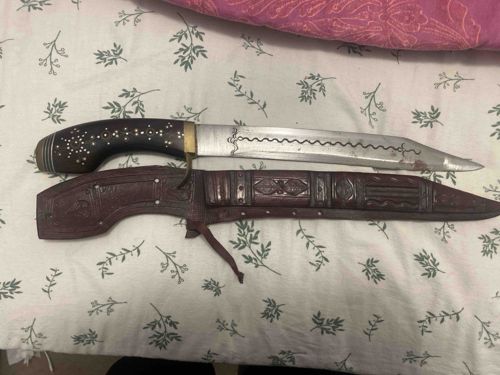
Indian Koummya Style Jambiya Dagger and Leather Scabbard

Arms and Armor / Edged Weapons

AI Estimated Value

·Not an official valuation·Verify before acting

$150 - $250

As of June 20, 2026

AI Item Analysis

·AI can make mistakes·Verify before acting
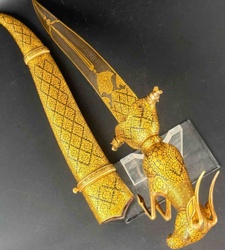
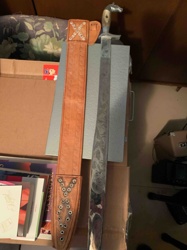
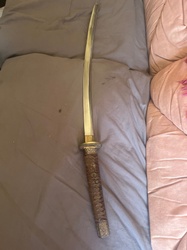
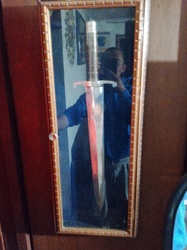
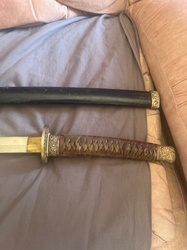
This item is a decorative fixed-blade dagger, likely of Indo-Persian or North African inspiration, specifically resembling a Koummya or Jambiya style. The blade features a distinctive curved, double-edged profile and is constructed from steel. A prominent aesthetic feature is the engraved wavy line or 'serpentine' motif running along the center of the blade, flanked by small circular punch marks and ending in floral etchings near the hilt. The hilt is crafted from a dark, likely tropical hardwood, ergonomically curved for a firm grip. It is heavily ornamented with intricate brass or silver-toned wire-inlay pinwork, forming geometric and floral star patterns. A brass bolster and pommel cap secure the handle. The accompanying scabbard is made of stiff, dark brown leather with deep, hand-tooled embossed geometric patterns, showing some surface cracking and honest wear. Condition-wise, the blade shows visible oxidation spots, minor pitting, and some darkening near the tip, indicating it has not been polished recently. The brass fittings show a natural aged patina. Based on the craftsmanship and decorative style, this piece likely dates from the mid-to-late 20th century as a high-quality souvenir or folk craft piece.
AI Appraisal Report

·AI can make mistakes·Verify before acting
I have carefully examined the provided images of this Koummya-style dagger. The piece exhibits the classic 'shote' curved blade and flared pommel characteristic of Moroccan and North African edged weapons, though manufactured for the tourist or export market. The hardwood hilt features elaborate brass pinwork in a 'star and cluster' motif typical of 20th-century craftsmanship. The leather scabbard’s deep embossing and the blade’s stamped 'serpentine' engravings are indicative of folk-art production rather than high-tier military or aristocratic commissions. Condition and Authenticity: The blade shows significant oxidation and pitting, particularly toward the tip, and the brass elements possess a heavy patina. While these signs imply age, the simplified geometry of the hilt and the quality of the steel suggest a mid-to-late 20th-century origin. It is a decorative item rather than a functional weapon or an 18th/19th-century antique. Market Conditions: Market demand for souvenir-grade Koummyas remains steady but modest. Comparable items frequently sell at regional auctions and online marketplaces within the $150 to $250 range. The lack of precious metal (silver) inlays limits the value to the lower end of the specialty edged-weapon market. Limitations: This appraisal is based solely on digital images. A physical inspection is required to determine the specific alloy of the inlays and to verify if the blade is hand-forged or factory-stamped. Full authentication would require provenance documentation or metallurgical testing to precisely date the steel. Without evidence identifying this as a historical piece from a known collection, it should be treated as a high-quality decorative souvenir.

Get your items appraised

Instant estimates of your treasures with AI-powered appraisals

Browse More Appraisals