AI estimate as of November 1, 2025 · verify with a professional before acting
AI-Generated · Verify before acting
Everything on this page is generated by AI for informational purposes only. AI can make mistakes — the AI may misidentify items or misattribute them (artist, maker, brand, designer, origin, era). This is not an official valuation and should not be used for insurance, sale, tax, estate, legal, or lending purposes — or any decision requiring a certified appraisal. It is not an authoritative claim about any person, brand, or rights holder — do not share or rely on it as a factual statement about a third party. Always consult qualified professionals before making financial decisions.
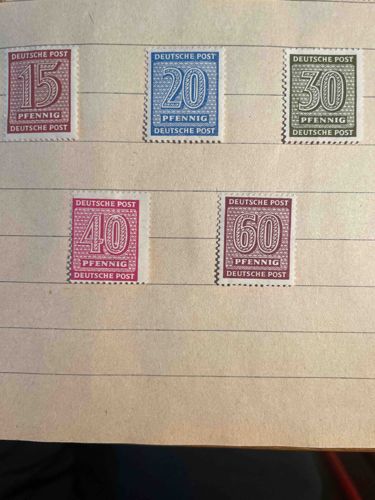
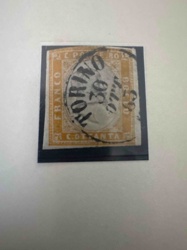
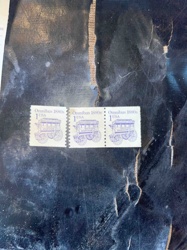
This item consists of five individual postage stamps from 'DEUTSCHE POST', likely arranged in a stamp album or on a specialized collector's page. Each stamp features a prominent numerical denomination in a large, stylized font, centered within a rectangular border. Above and below the numeral, the words 'DEUTSCHE POST' are printed, with 'PFENNIG' appearing directly beneath the numerical value. The denomination values visible are 15, 20, 30, 40, and 60 Pfennig. The 15 Pfennig stamp is red/maroon, the 20 Pfennig is blue, the 30 Pfennig is green, the 40 Pfennig is pink/magenta, and the 60 Pfennig is a darker plum or maroon color. All stamps exhibit a consistent design featuring a finely stippled or patterned background within their central square. They are perforated around their edges, indicating their postal use and separation from larger sheets. The stamps appear to be in good condition, with no immediate visible tears, creases, or major discoloration. Their colors are bright and distinct. They are affixed to a light tan, possibly cream-colored, paper surface with horizontal lines, typical of a stamp album page. The alignment and spacing suggest they have been carefully placed. This set represents a definitive issue series from the Deutsche Post, likely issued in the mid-20th century, possibly during the post-WWII period or early Federal Republic of Germany era. The craftsmanship is typical of national postal services, emphasizing clarity and security features, though specific engraving details are not clearly visible. The overall appearance suggests collectible quality.
AI Appraisal Report
I have examined the provided image of these five Deutsche Post Pfennig Definitive Postage Stamps (15, 20, 30, 40, 60 Pfennig). Visually, the stamps appear to be in good condition, exhibiting bright colors and no immediate signs of tears, creases, or major discoloration. The perforations seem intact. The consistent design and clear denominations suggest they are authentic definitive issues from the Deutsche Post, likely from the post-WWII or early Federal Republic of Germany period (such as the 'Band- und Brücken' series which this design resembles). They are neatly affixed to what appears to be an album page, indicating careful handling by a previous owner.
Based on market conditions for this specific type of German definitive postage, common post-war issues like these are generally quite plentiful. There isn't significant rarity associated with common denominations in good used or unused condition, especially when part of a standard series. Demand is primarily from beginner to intermediate collectors of German philately.
The primary factor impacting value here is the commonness of these issues. While their condition is good, they lack any obvious rare postmarks, errors, or unique variations that would significantly increase their worth. Without an in-person examination, it's impossible for me to definitively confirm authenticity, gum condition (if unused), or identify any subtle printing varieties or hinge remnants that could affect value. Factors like expert certifications, plate flaws, or imperforate errors often require physical inspection and specialized knowledge. Therefore, my appraisal relies solely on the visual information provided and assumes they are standard, genuine examples.
For full authentication, I would need to physically inspect the stamps to verify watermarks, paper type, gum, and microscopic details of the printing, and potentially compare them with known exemplars or obtain a certificate from a recognized philatelic authority.