AI estimate as of August 14, 2025 · verify with a professional before acting
AI-Generated · Verify before acting
Everything on this page is generated by AI for informational purposes only. AI can make mistakes — the AI may misidentify items or misattribute them (artist, maker, brand, designer, origin, era). This is not an official valuation and should not be used for insurance, sale, tax, estate, legal, or lending purposes — or any decision requiring a certified appraisal. It is not an authoritative claim about any person, brand, or rights holder — do not share or rely on it as a factual statement about a third party. Always consult qualified professionals before making financial decisions.
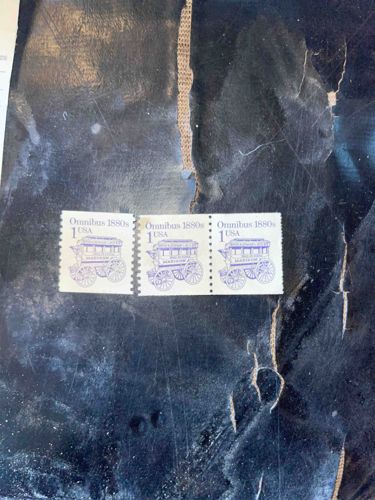
The item consists of three identical, unused postage stamps, still joined together in a horizontal strip. Each stamp depicts an 'Omnibus 1880s' in a monochromatic purple or violet ink against a white or off-white background. The design features a detailed illustration of a horse-drawn omnibus, a type of public transport vehicle common in the late 19th century. Below the image, the text 'Omnibus 1880s' is clearly printed, followed by '1 USA' indicating the denomination of 1 cent and the country of origin, United States of America. Each stamp has serrated perforations around all four edges, typical for postage stamps, suggesting they are meant to be separated for individual use. The stamps appear to be in excellent, uncirculated condition, with no visible signs of creasing, tearing, or foxing. The colors are vibrant and consistent across all three stamps, indicating good preservation. There are no discernible cancellations or markings that would suggest they have been used for postage. The reverse side is not visible, so the condition of the adhesive gum cannot be assessed. Based on the 'Omnibus 1880s' inscription and common philatelic issues referencing historical periods, these stamps likely belong to a commemorative series and could date from the latter half of the 20th century or early 21st century, rather than being from the 1880s themselves. The craftsmanship appears to be standard for government-issued postage, with clear, precise printing and consistent perforation.
AI Appraisal Report
I've examined the provided image of the USA 'Omnibus 1880s' 1-Cent Postage Stamps (Strip of 3). Based on this visual inspection, the strip appears to be in excellent, uncirculated condition. The stamps exhibit strong, vibrant purple/violet coloration, consistent printing, and intact, well-defined perforations. There are no visible signs of creasing, tears, foxing, or cancellations, which strongly suggests they are unused and well-preserved. My assessment of authenticity, based solely on the image, aligns with typical government-issued postage; the design elements, text, and perforations appear standard. The 'Omnibus 1880s' inscription, while depicting a historical scene, clearly identifies these as modern commemorative stamps and not actual stamps from the 1880s.
Market conditions for modern, common denomination U.S. commemorative strips in pristine, unused condition are generally stable but not highly speculative. While these are attractive, they are not considered rare. Demand is primarily from general collectors or those specializing in U.S. commemoratives. The 1-cent denomination indicates a very common issue, meaning millions would have been printed. This commonality significantly limits their individual or strip value. Factors positively impacting value are their pristine, unused state; factors limiting value are their common denomination and modern issue date.
It’s crucial to note that full authenticity verification and a precise condition assessment cannot be definitively made from images alone. A physical in-person examination would be necessary to inspect the reverse side for gum condition (mint never hinged vs. hinged), check for subtle imperfections not visible in the photo, and confirm paper type and phosphorescence if applicable. While unlikely for this common modern issue, scientific testing or detailed provenance documentation would be required to rule out counterfeits or alterations for more valuable or rare stamps.