AI Appraisal Estimate

AI-generated estimates · not official valuations

From the user

What was submitted

Photo and notes provided by the user — not generated by AI

Submitted item photo
Submitted photo · June 20, 2026

User's notes

No additional notes provided.

AI analysis below

AI appraisal

AI analysis & estimate

AI-Generated · Verify before acting

Everything below is generated by AI for informational purposes only. AI can make mistakes — the AI may misidentify items or misattribute them (artist, maker, brand, designer, origin, era). This is not an official valuation and should not be used for insurance, sale, tax, estate, legal, or lending purposes — or any decision requiring a certified appraisal. It is not an authoritative claim about any person, brand, or rights holder — do not share or rely on it as a factual statement about a third party. Always consult qualified professionals before making financial decisions.

Read the full disclaimer

AI Identification

·Not independently authenticated·Verify before acting

Vintage Cartoon Santa Claus Christmas Ceramic Mug

Kitchenware & Collectible Ceramics

AI Estimated Value

·Not an official valuation·Verify before acting

$8.00 - $12.00

As of June 20, 2026

AI Item Analysis

·AI can make mistakes·Verify before acting
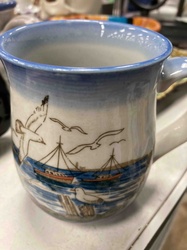
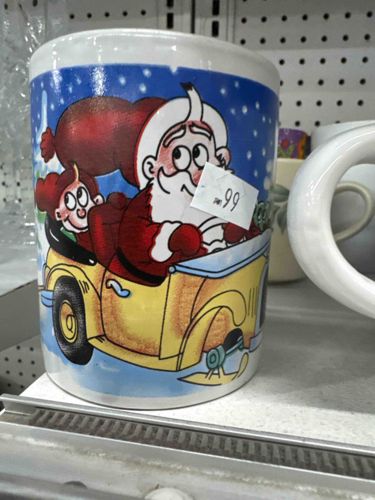
This is a cylindrical ceramic coffee mug featuring a wrap-around graphic design in a retro cartoon style. The illustration depicts a stylized Santa Claus with a large white beard and red suit driving a yellow vintage-style car through a snowy blue background. An elf-like figure with red hair is visible in the passenger seat. The color palette is vibrant, using primary yellows, reds, and blues against a white glazed ceramic body. The construction appears to be standard slip-cast ceramic with a high-gloss clear glaze finish. There is a visible white pricing sticker of '.99' adhered to the side of Santa’s face. Regarding condition, the glaze shows some minor shelf wear and dullness consistent with age, particularly along the bottom rim. There are no major visible cracks or chips from this angle, though the surface shows light pitting common in mid-century or late-20th-century mass-produced novelty ceramics. The character design is reminiscent of 1970s or 1980s greeting card illustrations. No maker's mark is visible in this view, as any potential branding or country-of-origin stamps would likely be located on the bottom of the base. The handle is partially visible on the right, showing a sturdy, rounded D-shape typical of utility drinkware.
AI Appraisal Report

·AI can make mistakes·Verify before acting
Upon my visual inspection of this vintage ceramic Christmas mug, I have identified it as a mass-produced novelty item likely dating from the late 1970s to the mid-1980s. The graphic style is characteristic of holiday stationary and budget-focused giftware from that era. The condition is fair to good; while the gloss remains largely intact, the presence of surface pitting and visible shelf wear on the footring indicates a history of use. The '$.99' adhesive sticker on the surface suggests the item has cycled through a thrift or secondary market recently, though it should be removed carefully to avoid any adhesive staining or glaze damage. The market for mid-century and late-20th-century Christmas ceramics remains steady, primarily driven by nostalgia and 'kitsch' collectors. This specific design, featuring a Santa in a vintage vehicle, is charming but not attributed to high-value manufacturers like Holt-Howard or Napco, which limits its rarity. Comparable items currently sell in the $5 to $15 range at antique malls and online marketplaces. There are significant limitations to this appraisal based on photographic evidence. I cannot verify the presence of a maker's mark or country-of-origin stamp (e.g., 'Japan' or 'Korea') typically found on the base. A physical examination is required to check for 'crazing' (micro-cracks in the glaze) or internal hairlines not visible in the image, both of which would devalue the piece for functional use. Final authentication would depend on inspecting the base for brand markings and confirming the absence of lead-based glaze, which was common in imported ceramics of that period.

Get your items appraised

Instant estimates of your treasures with AI-powered appraisals

Browse More Appraisals