AI Appraisal Estimate

AI-generated estimates · not official valuations

From the user

What was submitted

Photo and notes provided by the user — not generated by AI

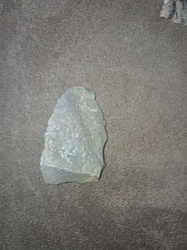
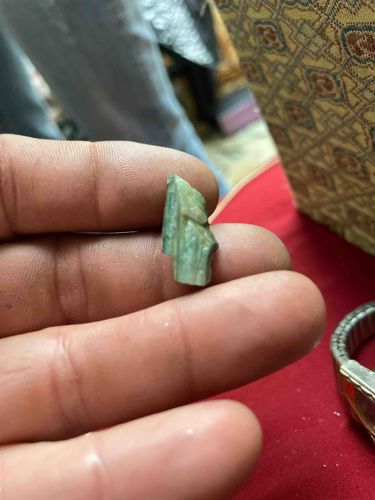
Submitted item photo
Submitted photo · June 22, 2026

User's notes

No additional notes provided.

AI analysis below

AI appraisal

AI analysis & estimate

AI-Generated · Verify before acting

Everything below is generated by AI for informational purposes only. AI can make mistakes — the AI may misidentify items or misattribute them (artist, maker, brand, designer, origin, era). This is not an official valuation and should not be used for insurance, sale, tax, estate, legal, or lending purposes — or any decision requiring a certified appraisal. It is not an authoritative claim about any person, brand, or rights holder — do not share or rely on it as a factual statement about a third party. Always consult qualified professionals before making financial decisions.

Read the full disclaimer

AI Identification

·Not independently authenticated·Verify before acting

Carved Green Gemstone Amulet or Totem Fragment

Archaeological Artifacts & Semiprecious Stone Carvings

AI Estimated Value

·Not an official valuation·Verify before acting

$150-300

As of June 22, 2026

AI Item Analysis

·AI can make mistakes·Verify before acting
This item is a small, hand-carved sculptural fragment fashioned from a green mineral, likely nephrite jade, aventurine, or a similar silicate gemstone. The piece measures approximately 1.5 to 2 centimeters in length and is held between fingers for scale. It exhibits a pale celadon to forest green color with a waxy to vitreous luster and visible internal crystalline structures. The carving appears to represent a stylized zoomorphic or anthropomorphic figure, potentially an archaic totem or deity. Notable features include a vertical ridge and tiered geometric carvings that suggest a seated figure or a specific symbolic motif common in Mesoamerican or Neolithic Chinese cultures. The condition is fragmentary; there is a significant linear break at the top edge and irregular fracturing at the base, indicating it was once part of a larger ornament or pendant. Surface wear and soft rounding of the carved edges suggest significant age or handling. The craftsmanship involves fine abrading and incising techniques. While no maker's marks are visible due to its size and fragmentary nature, the stylistic elements point toward an indigenous or ancient traditional artifact. The patina is consistent with burial or long-term skin contact, showing a slight softening of the stone's natural translucency.
AI Appraisal Report

·AI can make mistakes·Verify before acting
Based on my visual examination of this carved green gemstone fragment, I identify it as a small, hand-abraded artifact, likely crafted from a lower-grade nephrite or aventurine quartz. The piece measures under 2cm and exhibits the characteristic waxy luster and internal fracturing of an aged silicate mineral. The carving style—featuring tiered geometric ridges and a possible stylized zoomorphic form—loosely evokes motifs found in Neolithic Chinese (Hongshan culture) or Mesoamerican lapidary work. However, the lack of distinct iconography makes cultural attribution speculative without provenance. The condition is significantly compromised; it is clearly a fragment of a larger ornament, with major breaks at both the superior and inferior terminals. The edges show significant rounding and softening, consistent with either genuine burial patina or long-term tumbling, though distinguishing between ancient wear and modern 'antiquing' is impossible without microscopic trace-wear analysis. Value is driven primarily by its aesthetic appeal as a curiosity rather than as a museum-grade specimen, given its incomplete state. Comparables for fragmented, minor stone artifacts of uncertain attribution generally struggle in the high-end market but sell steadily in the curiosity and study-piece sector. While intact jade amulets command high prices, fragments like this are valued modestly. For full authentication, I would require X-ray fluorescence (XRF) to confirm the mineral composition and a microscopic review of the tool marks to rule out modern rotary tools. Without provenance documentation linking this to a specific archaeological site or collection, I must appraise this conservatively as a decorative historical fragment rather than a confirmed antiquity.

Get your items appraised

Instant estimates of your treasures with AI-powered appraisals

Browse More Appraisals