AI Appraisal Estimate

AI-generated estimates · not official valuations

From the user

What was submitted

Photo and notes provided by the user — not generated by AI

Submitted item photo
Submitted photo · June 22, 2026

User's notes

No additional notes provided.

AI analysis below

AI appraisal

AI analysis & estimate

AI-Generated · Verify before acting

Everything below is generated by AI for informational purposes only. AI can make mistakes — the AI may misidentify items or misattribute them (artist, maker, brand, designer, origin, era). This is not an official valuation and should not be used for insurance, sale, tax, estate, legal, or lending purposes — or any decision requiring a certified appraisal. It is not an authoritative claim about any person, brand, or rights holder — do not share or rely on it as a factual statement about a third party. Always consult qualified professionals before making financial decisions.

Read the full disclaimer

AI Identification

·Not independently authenticated·Verify before acting

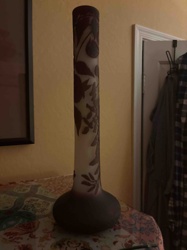
Art Nouveau Style Frosted Cameo Glass Vase

Art Glass / Decorative Antiques

AI Estimated Value

·Not an official valuation·Verify before acting

$450 - $700

As of June 22, 2026

AI Item Analysis

·AI can make mistakes·Verify before acting
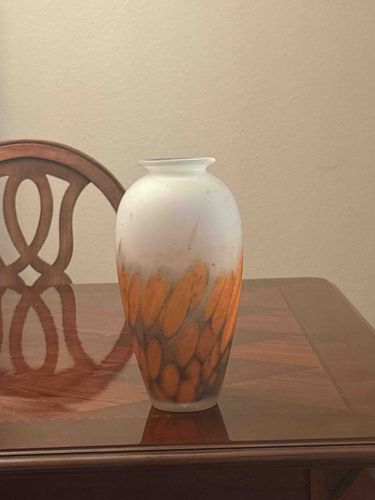
This item is an ovoid-shaped art glass vase, likely crafted in the 'Cameo Glass' or acid-etched style popularized by French makers like Daum or Gallé. Standing at a medium height, the piece features a frosted, opalescent white ground on the upper half, transitioning into a multi-layered orange and amber pattern on the lower section. The decorative elements consist of stylized, elongated oval shapes or 'petals' that appear to be etched or applied, creating a textured, organic rhythm reminiscent of the Art Nouveau period. The colors range from a deep burnt orange to a pale ochre, with dark brown or black striations outlining the floral-adjacent forms near the base. The glass possesses a matte, 'acid-finished' texture rather than a high-gloss sheen. The rim is slightly flared and finished with a clean, polished edge. Regarding condition, the vase appears physically intact without visible cracks or large chips from this perspective; however, some faint surface scuffs or atmospheric soiling can be seen on the white frosted area, which is common for matte glass of this age. There are no immediate signatures or maker's marks visible on the body, though such marks are typically found etched near the base or on the underside. Given the style, it is likely a mid-20th-century production or a high-quality contemporary revival following the techniques of the early 1900s French glass schools. The craftsmanship is indicated by the evenness of the etching and the controlled gradient of the glass strata.
AI Appraisal Report

·AI can make mistakes·Verify before acting
I have carefully examined the provided images of this Art Nouveau style cameo glass vase. The piece exhibits characteristic acid-etching techniques and a multi-layered 'strata' approach common in the Nancy School tradition. The transition from a frosted opalescent ground to the deep honey and burnt orange tones is well-executed, showing professional control of the chemical etching process. Physically, the vase appears in good condition; the surface scuffs noted on the frosted ground are consistent with age-related handling of matte glass and do not significantly detract from its aesthetic appeal. While the style strongly evokes the works of Daum Frères or Gallé, the absence of a visible signature and the specific geometry of the 'petal' motifs suggest this may be a high-quality mid-20th-century homage or a contemporary studio piece rather than an original turn-of-the-century masterpiece. The market for unsigned cameo glass remains stable, though it lacks the premium commanded by verified 1900-1915 pieces which often reach four to five figures. Valuation is based on recent auction results for high-quality acid-etched glass of indeterminate origin. Please note that this appraisal is based solely on visual evidence. A physical inspection is required to check for 'micro-signatures' or pontil marks on the base. Furthermore, verification of authenticity would require ultraviolet light testing to examine the glass composition and provenance documentation to trace its history. Without a confirmed maker’s mark, the value relies on the decorative merit and technical execution of the layering.

Get your items appraised

Instant estimates of your treasures with AI-powered appraisals

Browse More Appraisals