AI estimate as of July 7, 2025 · verify with a professional before acting
AI-Generated · Verify before acting
Everything on this page is generated by AI for informational purposes only. AI can make mistakes — the AI may misidentify items or misattribute them (artist, maker, brand, designer, origin, era). This is not an official valuation and should not be used for insurance, sale, tax, estate, legal, or lending purposes — or any decision requiring a certified appraisal. It is not an authoritative claim about any person, brand, or rights holder — do not share or rely on it as a factual statement about a third party. Always consult qualified professionals before making financial decisions.
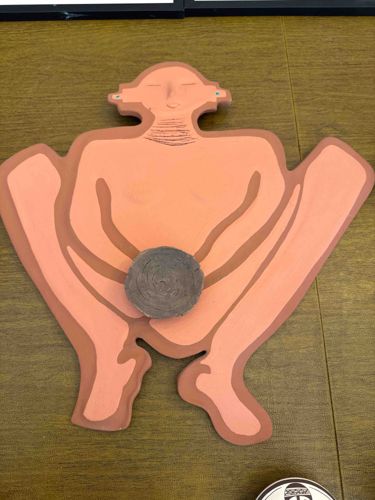
This appears to be a folk art sculpture depicting a stylized human figure, possibly a female or gender-neutral birthing figure, crafted from a light brown or tan material, most likely wood or a composite board such as MDF, cut into a flat, irregular shape. The primary color of the figure itself is a terracotta or peach hue, with outlines and internal anatomical lines (such as the arms and legs) painted in a darker, reddish-brown color, giving it a somewhat layered or dimensional appearance despite its flatness. The figure is shown in a squatting or seated position with legs widely spread. The head is minimalist, with closed eyes, a simple nose, and a small, upward-curving mouth suggesting a serene or pleasant expression. There are horizontal lines or striations painted on the neck area, possibly indicating folds of skin or a necklace. Small, circular light blue or light green dots are visible near the ears on both sides, possibly representing earrings or other adornments. A prominent, dark brown, circular, disk-like object is centrally located at what would be the abdomen or pelvic region, appearing to be adhered to the surface. This circular element has concentric ring patterns, suggesting it could be made from coiled clay, wood, or a similarly textured material. The overall condition appears good, with no obvious signs of significant damage like cracks or chips; the paint finish seems matte. The craftsmanship indicates a hand-made item, likely part of a devotional, educational, or artistic series given its specific and culturally resonant imagery. The piece has a somewhat primitive or stylized aesthetic, typical of folk art. Its subject matter and form suggest it might be part of a collection related to matriarchy, fertility, or ancestral figures.
AI Appraisal Report
I have carefully examined the provided images of this Stylized Squatting Figure Folk Art Sculpture. Based on the visual evidence, the condition appears good, with no obvious cracks, chips, or significant paint loss. The matte finish and painted details suggest it's a hand-made piece, consistent with folk art traditions. The craftsmanship indicates authenticity as a folk art object, likely devotional or symbolic. However, without physical examination, I cannot definitively verify the materiality (wood vs. composite), the adhesion of the central disk, or detect any subtle repairs or surface irregularities. Provenance documentation, such as the artist's identity, origin, or exhibition history, would significantly aid in full authentication and value assessment. Scientific testing of materials (e.g., paint analysis, wood identification) would further confirm composition and age.
In terms of market conditions, there is a consistent, niche demand for unique spiritual, symbolic, or 'visionary' folk art. This piece's theme, potentially related to fertility, matriarchy, or ancestral figures, connects it to a strong collecting category. Comparables would include other stylized, hand-carved, or painted folk art figures with spiritual or symbolic meaning, particularly those by known self-taught artists. Anonymous works like this typically command lower values unless they present exceptional aesthetic quality or known cultural significance. While unique, it's not exceptionally rare within the broader folk art market. The primary factors impacting value here are its compelling imagery, good apparent condition, and the overall aesthetic quality. The lack of an artist attribution or detailed provenance limits its top-tier market potential. Its appeal lies largely in its evocative subject matter and primitive charm.