AI estimate as of November 21, 2025 · verify with a professional before acting
AI-Generated · Verify before acting
Everything on this page is generated by AI for informational purposes only. AI can make mistakes — the AI may misidentify items or misattribute them (artist, maker, brand, designer, origin, era). This is not an official valuation and should not be used for insurance, sale, tax, estate, legal, or lending purposes — or any decision requiring a certified appraisal. It is not an authoritative claim about any person, brand, or rights holder — do not share or rely on it as a factual statement about a third party. Always consult qualified professionals before making financial decisions.
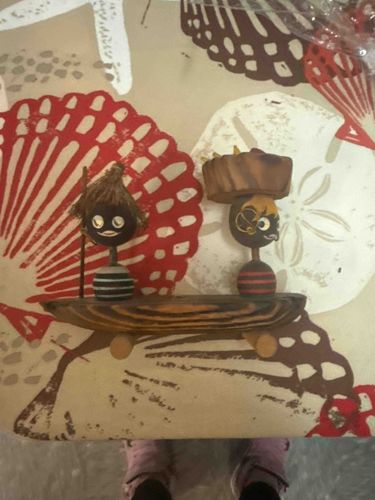
This appears to be a folk art sculpture depicting two stylized figures, possibly representing 'island people' or caricatures, seated within a canoe-like vessel. The item is crafted primarily from wood, with visible natural wood grain and some areas painted. The canoe itself is a flat, elongated piece of wood with an undulating, wave-like edge profile, and features painted horizontal stripes in a natural wood tone and a darker shade. It rests on two small, cylindrical wooden 'feet' or supports. Perched on the canoe are two figures. Each figure consists of a spherical 'head' attached to a striped cylindrical 'body' or base. The figure on the left has a dark brown, possibly coco-nut like head, topped with a tuft of fibrous material resembling hair. Its face is simplified with white, oval eyes and a white, open mouth. It holds a thin, dark stick, perhaps a paddle or spear. The figure on the right also has a dark, spherical head, but its 'hair' is a more solid, carved wooden piece resembling a basket or a headdress, again in a natural wood tone. Its face features white, oval eyes and a black 'M' shaped mouth, with some yellow-gold coloring around the eyes. The cylindrical body of the left figure has black and white horizontal stripes, while the right figure's body has red and black horizontal stripes. The overall construction suggests hand-carved and hand-painted elements, indicating a folk art or artisanal piece. The wood shows a natural patina and some minor surface wear consistent with age and handling. There are no immediate visible signs of major damage or repair, but closer inspection would be required to confirm. The style suggests a whimsical or tourist art aesthetic, likely from the mid to late 20th century. The craftsmanship is charmingly rustic, typical of decorative folk art.
AI Appraisal Report
Upon visual examination of the provided images, I have assessed this Folk Art 'Island People' Canoe Sculpture. The piece presents as a charming, hand-carved and hand-painted decorative object, likely intended for the tourist market. Its style is consistent with mid to late 20th-century artisanal crafts. The condition appears to be good, with minor surface wear and a natural patina appropriate for its age, but no major cracks, breaks, or repairs are visible.
The value of such an item is primarily determined by its decorative appeal rather than an established artist's reputation. The craftsmanship is rustic and whimsical, which has a certain market but is not considered high art. Comparable unsigned folk art or tourist souvenir sculptures from this era typically trade in a modest price range. The demand for anonymous decorative folk art of this type is generally moderate and subject to trends in interior design. Its lack of signature or discernible maker's mark significantly limits its value, as it cannot be attributed to a known or collected artist.
Based on these factors and current market conditions for similar decorative folk art, I would place its fair market value at $40 to $60. It is crucial to note the limitations of this appraisal. Without physical inspection, I cannot definitively confirm the materials, age, or rule out subtle repairs. A full authentication would require in-person examination to assess the wood type, tool marks, and physical signature or markings, as well as any provenance or sales records that could link it to a specific region or artisan.