AI estimate as of November 9, 2025 · verify with a professional before acting
AI-Generated · Verify before acting
Everything on this page is generated by AI for informational purposes only. AI can make mistakes — the AI may misidentify items or misattribute them (artist, maker, brand, designer, origin, era). This is not an official valuation and should not be used for insurance, sale, tax, estate, legal, or lending purposes — or any decision requiring a certified appraisal. It is not an authoritative claim about any person, brand, or rights holder — do not share or rely on it as a factual statement about a third party. Always consult qualified professionals before making financial decisions.
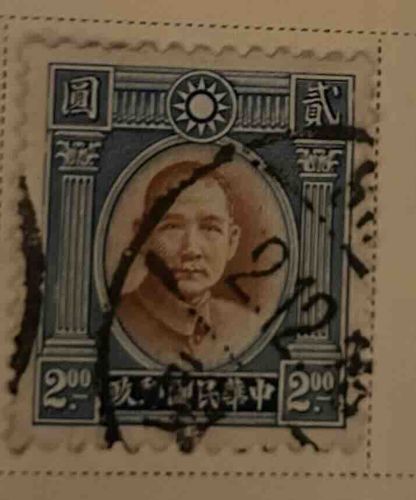
This is a vintage postage stamp from the Republic of China featuring a portrait of Chiang Kai-shek. The stamp is characterized by its rectangular shape with perforated edges, indicative of its philatelic purpose. The central image is a bust portrait of Chiang Kai-shek, rendered in a muted color palette, possibly sepia tones or a light brown, set against a circular, lighter background, possibly cream or light blue. The circular portrait is framed within an elaborate, rectangular border that appears to be blue or grayish-blue. This border features neoclassical architectural elements, including columns and decorative motifs, suggesting a formal and official design. Above the portrait, there is an emblem resembling the 'Blue Sky with a White Sun' national emblem of the Republic of China, positioned centrally. Text in traditional Chinese characters is visible around the border. In the upper right and left corners, there are vertical Chinese characters, and at the bottom, horizontal characters reading 'Zhong Hua Min Guo You Zheng' (‘Republic of China Post’). The denomination '200' is clearly visible in the lower left and right corners, likely indicating 200 Yuan. The stamp exhibits signs of use, primarily a prominent, heavy black cancellation mark that runs diagonally across the portrait and over parts of the denomination and border. This cancellation mark has obscured some details but confirms the stamp's postal use. The condition of the paper itself shows some discoloration and age-related wear, and the perforation integrity appears generally good, though some edges might show minor softening or separation. The overall aesthetic suggests a stamp from the mid-20th century, likely during Chiang Kai-shek's leadership.
AI Appraisal Report
Based on my visual examination of the provided image, this Chiang Kai-shek Republic of China 200 Yuan postage stamp appears to be an authentic example of the series issued during the mid-20th century. The design elements, including the portrait, national emblem, Chinese characters for 'Republic of China Post,' and '200' denomination, align with known issues of this period.
The condition, unfortunately, significantly impacts its value. The prominent, heavy black cancellation mark, while confirming postal use, heavily obscures the central portrait and other design elements. There's also visible age-related discoloration and wear to the paper. While the perforations appear generally intact, minor softening or separation is noted, consistent with its age and use. In the philatelic market, heavily cancelled or damaged stamps typically command lower prices compared to fine used or mint condition examples.
Market conditions for common Republic of China issues from this era are generally stable but not exceptionally strong, especially for used stamps. This particular denomination and design are not considered rare. Comparables for heavily cancelled examples of this specific stamp (Scott #876 or similar based on further identification) typically fall into the lower end of the pricing spectrum.
The value range I've provided reflects its authenticity as an issued stamp but acknowledges the significant aesthetic and philatelic limitations imposed by the heavy cancellation and general wear.
It is crucial to note that this authenticity verification is based solely on the image. For full authentication and a definitive appraisal, an in-person examination would be required. This would allow for inspection of paper type, watermarks (if any), printing methods, and micro-perforations, which cannot be reliably determined from an image. Additionally, a closer look at the actual cancellation—its ink, application, and any signs of manipulation—would be essential. Provenance documentation, if available, would further enhance its verifiable history.