These notes were written by the person who submitted this item. Appraiser.AI has not verified them, and the AI's identification and estimate may rely on them.
AI Estimated Value
Not an official valuation
$5 - $10
AI estimate as of November 10, 2025 · verify with a professional before acting
AI-Generated · Verify before acting
Everything on this page is generated by AI for informational purposes only. AI can make mistakes — the AI may misidentify items or misattribute them (artist, maker, brand, designer, origin, era). This is not an official valuation and should not be used for insurance, sale, tax, estate, legal, or lending purposes — or any decision requiring a certified appraisal. It is not an authoritative claim about any person, brand, or rights holder — do not share or rely on it as a factual statement about a third party. Always consult qualified professionals before making financial decisions.
This analysis also relies on unverified notes provided by the user, which may be incomplete or inaccurate and could affect the result.
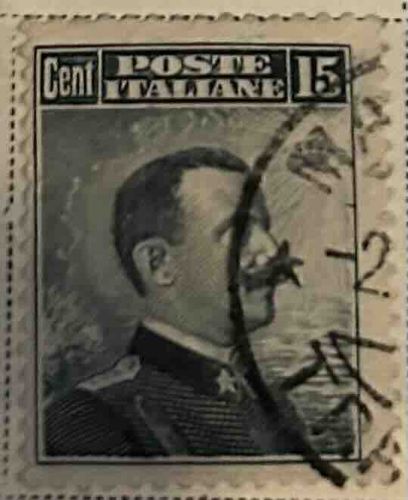
This is a vintage Italian postage stamp, featuring a portrait of Victor Emmanuel III, King of Italy, depicted in profile facing right. The stamp has a monetary value of '15' centesimi, indicated in the upper right corner, with the word 'Cent' visible in the upper left. The words 'POSTE ITALIANE' are prominently displayed across the top border above the portrait. The design is rendered in a monochrome, likely gray or sepia tone, suggesting an older printing process typical of early 20th-century philately. The stamp exhibits a perforated edge, which is standard for postage stamps, indicating it was designed to be easily separated from a sheet. Visible condition issues include a prominent, dark, curved cancellation mark that diagonally traverses the face of the stamp, obscuring part of the king's face and the value. Additionally, there are other lighter, diagonal markings (possibly part of the cancellation or another mark) in the upper right quadrant. The overall texture and slight discoloration suggest the paper has aged, possibly with some light staining or foxing not clearly discernible in detail. The portrait shows the king in what appears to be military attire, complete with epaulets and a star-shaped medal or insignia on his chest. The background behind the portrait is plain or subtly textured, drawing focus to the monarch. Given Victor Emmanuel III's reign and typical stamp issuance, this stamp likely dates from the early to mid-20th century. The quality of printing appears adequate for its time, with clear lines for the portrait and text, despite the age and cancellation. The presence of the cancellation mark indicates that the stamp has been used for postal purposes.
AI Appraisal Report
I have examined the provided image of the Italian 15 Centesimi Postage Stamp featuring Victor Emmanuel III. This stamp is an authentic issue from the 'Poste Italiane' series, depicting Victor Emmanuel III in profile. The design and typography are consistent with known examples of this era, likely dating from the early to mid-20th century.
However, the condition is significantly impacted by a prominent, dark cancellation mark that covers a substantial portion of the stamp, including the monarch's face and the value. There are additional lighter markings, possibly part of the cancellation. While aged paper and perforated edges are typical, the heavy cancellation is a major detractor. This particular stamp, Scott #102, is very common in used condition. Millions were printed and used.
In terms of market conditions, this stamp, in used and heavily canceled condition, does not command a high value. Uncanceled (mint) examples are more desirable, and even then, their value is modest unless they possess specific plate flaws or rare forms of cancellation. Comparables for heavily canceled examples typically range in the single-digit dollar figures. Rarity is low due to the high print run. Demand is generally from entry-level collectors or those seeking a complete run of the series, but they usually prefer clearer cancellations or unused examples.
The heavy cancellation significantly reduces its market appeal and, consequently, its value. Without the cancellation, and in fine used condition, the value would be slightly higher, perhaps up to $20. Due to the high liquidity and commonality of this stamp, there is little need for extensive in-person examination beyond confirming it is not a crude forgery, which is highly unlikely for such a low-value item. Full authentication via provenance documentation or scientific testing is not typically warranted for stamps of this type and condition, as the cost would far exceed the potential value.