AI estimate as of October 25, 2025 · verify with a professional before acting
AI-Generated · Verify before acting
Everything on this page is generated by AI for informational purposes only. AI can make mistakes — the AI may misidentify items or misattribute them (artist, maker, brand, designer, origin, era). This is not an official valuation and should not be used for insurance, sale, tax, estate, legal, or lending purposes — or any decision requiring a certified appraisal. It is not an authoritative claim about any person, brand, or rights holder — do not share or rely on it as a factual statement about a third party. Always consult qualified professionals before making financial decisions.
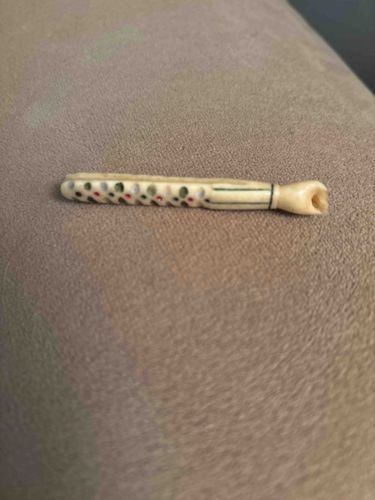
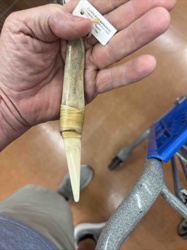
This appears to be a small, elongated implement, likely carved from bone or a similar natural material, possibly ivory. Its overall color is a creamy off-white, consistent with aged bone. The body of the implement is cylindrical and tapers slightly towards both ends. One end features an intricate carving of a clenched human or humanoid hand, with fingers curled into a fist-like shape and an open void where the hand would grasp something. Just below the hand, there are two thin, incised black rings or bands encircling the shaft. The main body of the implement is adorned with a series of small, recessed circular marks, creating a dotted pattern. These dots are individually hand-painted in alternating colors of red, green, and black, suggesting a deliberate decorative motif. The painting appears somewhat worn in places, indicating age and handling. There are also thin, incised lines running lengthwise along the shaft, giving it a fluted or grooved appearance in certain sections. The craftsmanship suggests a folk art or perhaps a utilitarian item with decorative elements. The material exhibits a smooth texture with some natural irregularities that might be grain lines or slight pitting inherent to bone. There are no overt signs of repair, but the overall patina suggests considerable age, potentially late 19th or early 20th century. Its exact function is not immediately clear from the image alone, but its size and hand-carved details suggest it could be a small tool, a decorative 'pick', a ceremonial object, or even part of a larger mechanism.
AI Appraisal Report
Based on my visual examination of the provided image, this Carved Bone Implement with Hand Motif appears to be an intriguing piece, likely of folk art origin. The creamy off-white color and visible irregularities are consistent with aged bone or possibly ivory, though confirmation would require in-person inspection. The craftsmanship, particularly the intricate hand carving and the meticulous application of the colored dots, suggests a deliberate and skilled artisan. The worn painting and overall patina are indicative of age and handling, aligning with a potential late 19th to early 20th-century origin. Condition appears good for its age, with wear consistent with use rather than significant damage, though hairline cracks or repairs would only be visible with physical examination.
Market conditions for folk art items like this can be quite variable. While the unique hand motif and colored decoration add to its appeal, its exact function remains unclear, which can impact broader market demand. Similar decorative 'picks' or ceremonial items, unless tied to a specific culture or verifiable age, typically fall into a modest price range. Rarity is difficult to assess without knowing its origin; it appears unique but not necessarily from a historically documented tradition. Factors impacting value positively are its apparent age, unique aesthetic, and seemingly good condition. However, the lack of known provenance and indeterminate function are limiting factors.
For full authentication and a more precise valuation, an in-person examination is crucial. This would allow for material analysis (bone vs. ivory), microscopic inspection of carving details and paint application for confirmation of age, and a more thorough assessment of condition, including any subtle repairs or environmental degradation. Scientific testing, such as C14 dating, could definitively establish age. Without these, the authenticity of age and material remains an informed visual assessment, not a definitive certification.