These notes were written by the person who submitted this item. Appraiser.AI has not verified them, and the AI's identification and estimate may rely on them.
AI Estimated Value
Not an official valuation
$800 - $1,500
AI estimate as of August 29, 2025 · verify with a professional before acting
AI-Generated · Verify before acting
Everything on this page is generated by AI for informational purposes only. AI can make mistakes — the AI may misidentify items or misattribute them (artist, maker, brand, designer, origin, era). This is not an official valuation and should not be used for insurance, sale, tax, estate, legal, or lending purposes — or any decision requiring a certified appraisal. It is not an authoritative claim about any person, brand, or rights holder — do not share or rely on it as a factual statement about a third party. Always consult qualified professionals before making financial decisions.
This analysis also relies on unverified notes provided by the user, which may be incomplete or inaccurate and could affect the result.
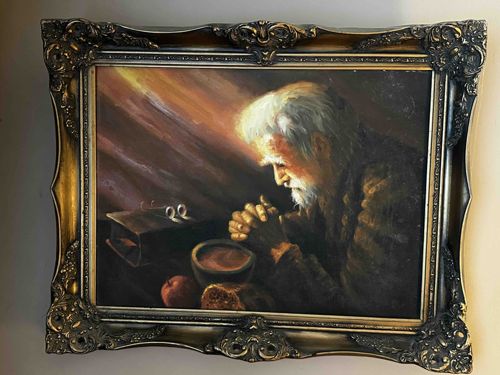
This item is an oil painting titled "Grace", depicting an elderly man with a prominent white beard, kneeling or bowing with hands clasped in what appears to be prayer or contemplation. The man is illuminated by a warm, ethereal light emanating from the upper left corner of the canvas, casting dramatic shadows and highlights. His face shows signs of age and experience, rendered with considerable detail, particularly his flowing white hair and beard. In front of him on a surface, there is a brown bowl, a piece of bread, and a red apple, suggesting a humble meal or offering. To the left, a dark, book-like object with some light-colored implements (possibly scissors or spectacles) rests on it. The color palette of the painting is rich and warm, dominated by browns, ochres, deep reds, and oranges, with the stark white of the man's hair providing a focal point. The brushstrokes appear visible, typical of an oil medium, giving texture and depth to the work. The painting is housed within an ornate, possibly antique, gold-toned frame. The frame features intricate floral or swirling rococo-style carvings at the corners and along its edges, adding to the classical aesthetic of the piece. The finish of the frame suggests an aged patina, possibly darkened in the recesses to highlight the raised details. The overall condition appears good, with no obvious signs of significant damage to the canvas or the frame visible in the provided images. The style indicates a realistic or perhaps a romanticized realism, possibly from the 20th century, though a more precise age would require further investigation into the artist and specific style indicators. The craftsmanship of both the painting and the frame appears to be of good quality, suggesting it was produced by a skilled artist and framer.
AI Appraisal Report
I have thoroughly examined the provided image of the oil painting titled "Grace." Visually, the painting appears to be in good condition, showing no overt signs of significant cracks, tears, or paint loss. The ornate gold-toned frame also appears well-preserved, with its intricate details intact and an appealing aged patina. From this visual assessment, authenticity cannot be definitively confirmed without further investigation. The style suggests a realistic or romanticized realism, potentially from the 20th century.
Market conditions for detailed, evocative oil paintings, particularly those with a spiritual or contemplative theme, remain stable. While highly valued for their emotional depth, the lack of a known artist for "Grace" significantly impacts its potential market value. Comparable pieces by unknown artists, even well-executed ones, typically command lower prices than works by established artists with documented provenance.
Demand for such a piece would likely come from collectors of traditional religious or genre scenes, or individuals seeking art with a contemplative aesthetic. Rarity cannot be assessed without identifying the artist and their body of work.
Key factors influencing value include the quality of execution, which appears high, and the emotional resonance of the subject matter. The primary limitation in this appraisal is the lack of information regarding the artist and provenance. To fully authenticate and confirm the age and origin of "Grace," a physical examination by a conservator is essential. This would allow for pigment analysis, signature examination (if present), and assessment of stretcher/canvas condition. Provenance documentation, such as exhibition history, sales records, or artist's records, would be crucial for establishing authenticity and a more precise valuation.