These notes were written by the person who submitted this item. Appraiser.AI has not verified them, and the AI's identification and estimate may rely on them.
AI Estimated Value
Not an official valuation
$300-500
AI estimate as of October 31, 2025 · verify with a professional before acting
AI-Generated · Verify before acting
Everything on this page is generated by AI for informational purposes only. AI can make mistakes — the AI may misidentify items or misattribute them (artist, maker, brand, designer, origin, era). This is not an official valuation and should not be used for insurance, sale, tax, estate, legal, or lending purposes — or any decision requiring a certified appraisal. It is not an authoritative claim about any person, brand, or rights holder — do not share or rely on it as a factual statement about a third party. Always consult qualified professionals before making financial decisions.
This analysis also relies on unverified notes provided by the user, which may be incomplete or inaccurate and could affect the result.
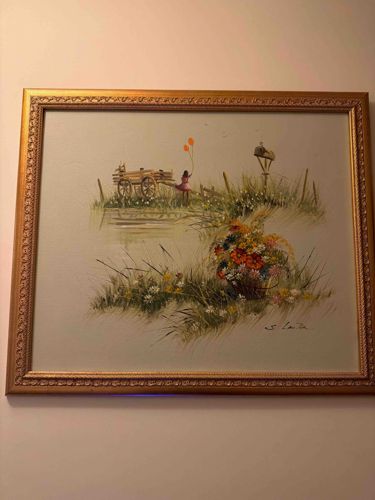
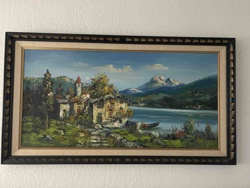
This is a framed oil painting depicting a pastoral landscape scene. The artwork is characterized by its light, airy brushstrokes and a muted color palette, with vibrant accents. The central focus includes a small figure of a girl, possibly a child, standing near a wooden cart or wagon, holding two orange balloons. The setting appears to be a grassy area with wildflowers, possibly near a body of water which reflects elements of the scene. To the right of the girl and wagon, there is a prominent basket overflowing with a colorful array of flowers, featuring reds, oranges, yellows, and white blossoms, suggesting a sense of abundance and natural beauty. Further right, a mail post with a bird's nest is visible. The foreground and mid-ground are rich with textured greenery and small floral details, while the background maintains a lighter, less detailed appearance. The artist's signature, which appears to read 'S. Latz' or similar, is located in the lower right corner of the painting. The painting is housed within a substantial gold-colored wooden frame with an ornate, possibly carved or molded, relief pattern along its inner and outer edges, adding to its classic aesthetic. The overall condition appears excellent, with no visible signs of damage, wear, or repairs to either the painting or the frame. The style suggests a decorative, possibly mid to late 20th-century piece, designed to bring a touch of natural charm to an interior space. The craftsmanship is competent, particularly in the detailed rendering of the flowers and the delicate brushwork for the grass and reflections.
AI Appraisal Report
Based on my visual examination of the provided image, this framed oil painting depicting a pastoral landscape with a girl and wagon appears to be in excellent condition, aligning with the owner's description. There are no visible signs of damage, wear, or repairs to either the painting or its ornate gold-colored wooden frame, which itself adds to the decorative appeal. The vibrant accents within the muted palette and the light, airy brushstrokes suggest a competent hand, particularly in the detailed rendering of the flowers and grass. The signature 'S. Latz' is a key identification point.
Market conditions for decorative, likely mid-to-late 20th-century landscape oil paintings by unlisted or lesser-known artists typically place them in the accessible rather than collectible category. Comparable works of similar size, style, and condition by artists without significant auction records generally fetch modest prices in secondary markets, such as online marketplaces or regional auctions. Demand is primarily from interior decorators or individuals seeking aesthetic appeal rather than investment. Rarity is not a significant factor here; similar decorative pieces are relatively common.
Factors significantly impacting value include the excellent condition of both the artwork and frame. However, the primary limiting factor is the apparent lack of a prominent artist (assuming 'S. Latz' doesn't correspond to a known, established artist with an auction history). To fully authenticate this piece and confirm the artist's identity and potential historical significance, an in-person examination would be crucial. Physical inspection would allow for detailed analysis of paint layers, brushwork intricacies, canvas type, and an accurate assessment of the frame's construction. Additionally, provenance documentation (history of ownership) is essential, and a definitive confirmation of the artist's full name and career would necessitate research into art databases and potentially discussions with art historians specializing in the period. Without these, the appraisal remains based on its decorative merit rather than its fine art investment potential.