AI estimate as of July 24, 2025 · verify with a professional before acting
AI-Generated · Verify before acting
Everything on this page is generated by AI for informational purposes only. AI can make mistakes — the AI may misidentify items or misattribute them (artist, maker, brand, designer, origin, era). This is not an official valuation and should not be used for insurance, sale, tax, estate, legal, or lending purposes — or any decision requiring a certified appraisal. It is not an authoritative claim about any person, brand, or rights holder — do not share or rely on it as a factual statement about a third party. Always consult qualified professionals before making financial decisions.
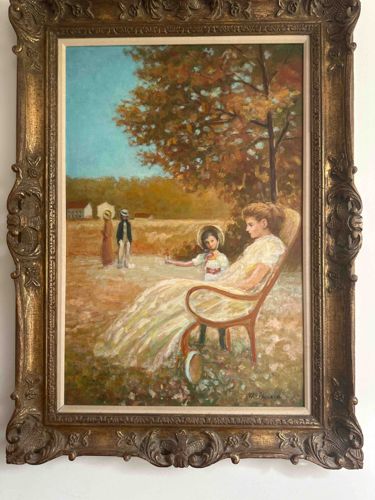
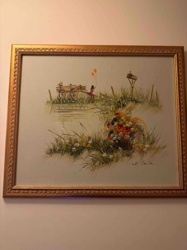
This is a framed oil painting depicting a pastoral scene with figures, likely from the late 19th or early 20th century, given the style of dress and the general aesthetic. The painting is housed in a substantial, ornate gilded frame, which appears to be carved wood or a highly detailed molded composition material, exhibiting a rich, dark gold finish with areas of deliberate antiquing or patina to enhance its aged appearance. The frame features intricate scrollwork and floral motifs at the corners and along the sides, indicative of a Rococo Revival or Baroque influence.
The artwork itself portrays a seated woman in a light-colored, flowing dress with voluminous sleeves, possibly of white or pale yellow hue, exhibiting a soft, painterly quality. Her hair is styled in an elaborate updo. She is seated in what appears to be a wooden armchair, positioned under the autumn foliage of a tree, indicated by the rich oranges and browns of its leaves. In front of her, a child in a bonnet holds out an object, seemingly interacting with the woman. Farther back in the scene, two other figures, adult-sized, are visible in a field, with what looks like small white buildings (farmhouses or outbuildings) in the distant background under a clear blue sky. The foreground features grassy ground with touches of red and purple flowers or foliage, executed with visible brushstrokes.
The painting's condition appears stable, with no obvious major damage visible such as tears, punctures, or significant paint loss. The frame shows some minor wear consistent with age, particularly where the gilt might be slightly rubbed on raised areas, contributing to its antique charm rather than detracting from it. The craftsmanship of the frame is high, suggesting it was original to or selected to complement a painting of quality. The artist's signature, "M. B. Powell" or similar, is faintly visible in the lower right corner, which would be crucial for further authentication and valuation. The overall impression is one of a well-preserved piece of art, showcasing a serene, possibly nostalgic, rural setting.
AI Appraisal Report
I have examined the provided image of this Pastoral Scene Oil Painting by M.B. Powell. The painting appears to be in stable condition, with no obvious major damage visible such as tears, punctures, or significant paint loss. The ornate gilded frame, likely Rococo Revival or Baroque, shows minor wear consistent with age, which adds to its antique charm. The presence of an artist's signature, "M. B. Powell" faintly visible in the lower right, is a positive factor for attribution. The scene itself, depicting figures in a serene landscape, is aesthetically pleasing and aligns with popular tastes for pastoral scenes from the late 19th or early 20th century.
Market conditions for unsigned or lesser-known artist oil paintings from this period can be variable. Demand typically exists for decorative pieces that are well-framed and in good condition. The quality of the frame significantly enhances the overall presentation and value. Rarity is difficult to assess without knowing more about M.B. Powell; if the artist is unlisted or has a limited market presence, it impacts the unique value. Factors significantly impacting value here include the decorative appeal, the integrity of the frame, and the condition of the artwork.
Limitations in authenticity verification are inherent when working solely from images. While the signature appears present, microscopic analysis would be needed to confirm its originality and not a later addition. An in-person examination would allow for a thorough condition assessment, including stretcher bar marks, craquelure, and varnish condition. Provenance documentation (prior ownership history, exhibition records) would be crucial for establishing authenticity and a comprehensive valuation, especially if M.B. Powell is a documented artist. Without further information and in-person inspection, this appraisal is based on its decorative and aesthetic merit as a period piece.