These notes were written by the person who submitted this item. Appraiser.AI has not verified them, and the AI's identification and estimate may rely on them.
AI Estimated Value
Not an official valuation
$0.50 - $1.50
AI estimate as of November 10, 2025 · verify with a professional before acting
AI-Generated · Verify before acting
Everything on this page is generated by AI for informational purposes only. AI can make mistakes — the AI may misidentify items or misattribute them (artist, maker, brand, designer, origin, era). This is not an official valuation and should not be used for insurance, sale, tax, estate, legal, or lending purposes — or any decision requiring a certified appraisal. It is not an authoritative claim about any person, brand, or rights holder — do not share or rely on it as a factual statement about a third party. Always consult qualified professionals before making financial decisions.
This analysis also relies on unverified notes provided by the user, which may be incomplete or inaccurate and could affect the result.
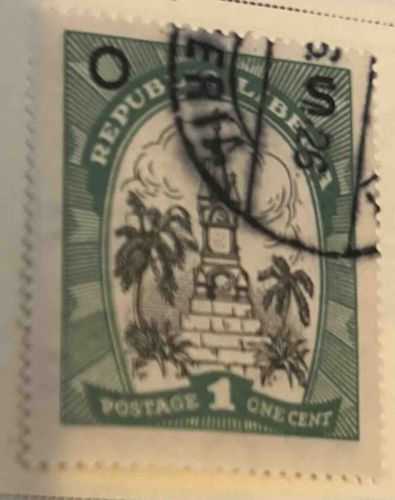
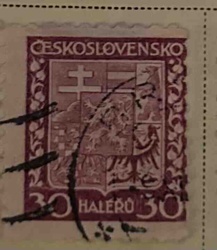
This is a vintage postage stamp from Liberia, featuring a central vignette of a clock tower flanked by palm trees. The stamp is predominantly green on a white background, with a rectangular shape and perforated edges. The design includes a curved banner at the top with the text "REPUBLI LIBERIA" (though 'C' is obscured by a postmark) and a lower banner stating "POSTAGE 1 ONE CENT". The central image depicts a multi-tiered clock tower, possibly a monument, with architectural details visible. Cloud-like formations are in the background behind the tower, and two prominent palm trees frame the monument on either side. Scattered smaller bushes or foliage are also visible at the base. The stamp has been used, as indicated by a prominent black circular or wavy postmark that partially obscures the 'C' in 'REPUBLIC' and much of the upper right corner, including parts of the text "LIBERIA". The perforations appear consistent around all edges, suggesting it was once part of a larger sheet. The overall condition shows signs of age and use typical of a circulated postage stamp, including the heavy postmark. There may be minor discoloration or toning to the paper, though this is difficult to assess precisely from the provided image. The printing quality appears to be standard for its era, with clear lines and detail in the engraving despite the small size. Without closer inspection of the reverse, details like watermarks or gum condition cannot be determined, but the front presents a recognizable and authentic postal artifact.
AI Appraisal Report
Upon examining the provided image of the Liberia 1 Cent Postage Stamp featuring the Clock Tower and Palm Trees, my assessment is that this is an authentic, used postage stamp from Liberia. The design, text, and denominations are consistent with known issues from that region and period. The predominant green color and perforated edges are typical. I observe a significant black circular or wavy postmark, which, while obscuring part of the "REPUBLIC" inscription, confirms it was used for postage. This postmark is heavy and impacts the clarity of a portion of the design, which generally lessens eye appeal and, consequently, value compared to a lightly cancelled or uncancelled example. The perforations appear consistent, suggesting it was properly separated from a sheet. Without a physical in-hand examination, I cannot definitively assess the gum condition, presence of watermarks, or the exact nuances of paper toning or any hidden faults such as thinning or repairs. These elements require direct inspection. Regarding market conditions, demand for common, heavily cancelled Liberian stamps of this era is generally modest among general collectors. Rarity is not a significant factor for this specific issue in used condition. Comparables for similar common, used Liberian stamps typically fall into the sub-dollar to low-dollar range, especially with a heavy cancel. Therefore, my estimated appraisal value reflects its used condition with a prominent postmark. For full authentication and a more precise valuation, an in-person examination by a reputable philatelist, preferably with expertise in African postal history, would be required. This would allow for detailed inspection of paper quality, gum presence (if any), watermarks, and any subtle damage or repairs not visible in the image.