AI Appraisal Estimate

AI-generated estimates · not official valuations

From the user

What was submitted

Photo and notes provided by the user — not generated by AI

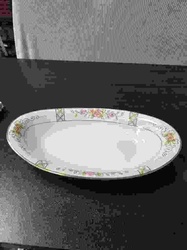
Submitted item photo
Submitted photo · June 3, 2026

User's notes

No additional notes provided.

AI analysis below

AI appraisal

AI analysis & estimate

AI-Generated · Verify before acting

Everything below is generated by AI for informational purposes only. AI can make mistakes — the AI may misidentify items or misattribute them (artist, maker, brand, designer, origin, era). This is not an official valuation and should not be used for insurance, sale, tax, estate, legal, or lending purposes — or any decision requiring a certified appraisal. It is not an authoritative claim about any person, brand, or rights holder — do not share or rely on it as a factual statement about a third party. Always consult qualified professionals before making financial decisions.

Read the full disclaimer

AI Identification

·Not independently authenticated·Verify before acting

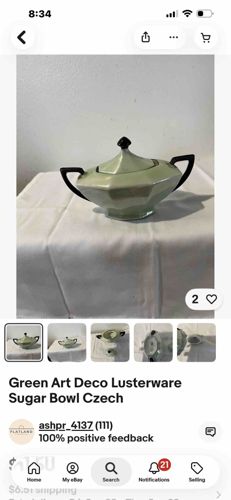
Czechoslovakian Art Deco Lusterware Sugar Bowl

Antique/Vintage Tableware & Ceramics

AI Estimated Value

·Not an official valuation·Verify before acting

$45.00 - $75.00

As of June 3, 2026

AI Item Analysis

·AI can make mistakes·Verify before acting
This is a vintage Art Deco period lidded sugar bowl, likely manufactured in Czechoslovakia during the 1920s or 1930s. The piece is crafted from fine porcelain or ceramic and features a distinctive geometric 'diamond' or angular profile characteristic of the era. The exterior is finished in a pale mint green luster glaze, which creates an iridescent, pearl-like sheen that shifts in the light. This is contrasted by matte black accents on the high-arching, angular geometric handles and the pointed finial atop the lid. The base is footed with a slight taper, following the octagonal or faceted silhouette of the main body. Measuring approximately 4-6 inches in height, the construction displays precise craftsmanship typical of European export porcelain from this period. Notable features include the sharp, clean lines and the stark transition between the soft luster body and the dark, bold handles. Based on the provided images, the item appears to be in very good condition with no immediate evidence of large chips or cracks, though light surface scuffing or minor rubbing on the iridescent finish is common for this type of ware. While specific maker's marks are not fully legible in the thumbnail, it adheres to the style often associated with firms like Victoria Schmidt or Ditmar Urbach produced specifically for the export market.
AI Appraisal Report

·AI can make mistakes·Verify before acting
Upon examination of this Czechoslovakian lusterware sugar bowl, I find it to be a quintessential example of Art Deco geometric ceramic production from the interwar period (1920-1930s). The design exemplifies the 'streamline' aesthetic, utilizing a faceted octagonal body and high-arched, matte black handles that provide a striking tonal contrast to the mint green pearlescent glaze. Based on visual inspection, the item appears to be in very good vintage condition; the luster remains vibrant without significant 'rubbing' or oxidation, which often plagues these delicate metallic-oxide glazes. The absence of visible hairline fractures in the angular handles—a common stress point—suggests careful preservation. The market for Czechoslovakian export porcelain remains steady but accessible. Comparables from manufacturers like Ditmar Urbach or Victoria Schmidt often sell in this range for individual serving pieces, whereas full tea sets command higher premiums from collectors of 'Between the Wars' European ceramics. The rarity is considered moderate; while the color palette is desirable, these items were produced in significant quantities for the American and British export markets. Limitation of Appraisal: This valuation is based solely on digital imagery. A physical examination is required to verify the presence of an underglaze backstamp (such as the 'Czechoslovakia' circle mark) and to check for professional restorations that may be invisible in photographs. For a definitive authentication, I would need to inspect the foot rim for appropriate wear patterns and utilize a high-intensity UV light to detect possible over-glaze fills or repairs to the finial and handles.

Get your items appraised

Instant estimates of your treasures with AI-powered appraisals

Browse More Appraisals