AI estimate as of September 8, 2025 · verify with a professional before acting
AI-Generated · Verify before acting
Everything on this page is generated by AI for informational purposes only. AI can make mistakes — the AI may misidentify items or misattribute them (artist, maker, brand, designer, origin, era). This is not an official valuation and should not be used for insurance, sale, tax, estate, legal, or lending purposes — or any decision requiring a certified appraisal. It is not an authoritative claim about any person, brand, or rights holder — do not share or rely on it as a factual statement about a third party. Always consult qualified professionals before making financial decisions.
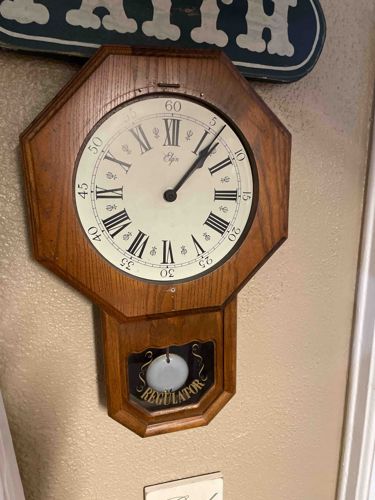
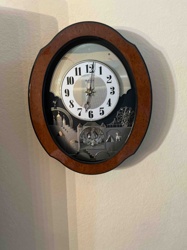
This is an octagonal wall-mounted regulator clock, likely dating from the mid to late 20th century, given its relatively clean design and lack of extensive antique-style ornamentation. The clock features a light-brown wooden case with visible grain, suggesting a common hardwood like oak or a similar species, finished with a clear varnish or stain. The main body of the clock is octagonal, housing a circular white or cream-colored dial. The dial prominently displays Roman numerals for hours (I through XII), with additional Arabic numerals for minute markers at intervals of five (05, 10, 15, ..., 60). The hour and minute hands are black and appear to be of a simple, elegant spade or Breguet style. Above the center of the dial, the brand name "Elgin" is subtly inscribed in a cursive font. Below the main clock face, a rectangular pendulum viewing window is integrated into the lower, smaller section of the case. This window is framed by the same wooden material and contains a glass panel behind which an off-white, circular pendulum bob is visible, swinging. The word "REGULATOR" is embossed or printed in an arch around the pendulum bob within this lower section, indicating its function as a time-keeping device designed for accuracy. The clock appears to be in good overall condition, with no immediate signs of significant damage, scratches, or wear on the wooden casing. The glass over the dial and pendulum window also appears intact and clear. The clean lines and functional design suggest a piece that prioritizes readability and reliability, characteristic of 'regulator' clocks.
AI Appraisal Report
I have examined the image of this Elgin Octagonal Wall Regulator Clock. Based on its clean lines, octagonal shape, and the presence of both Roman and Arabic numerals, I assess this piece to be a mid-to-late 20th-century production, rather than an earlier antique. The wooden case, likely oak or a similar hardwood with a clear finish, appears to be in good overall condition with no visible significant damage, scratches, or wear. The glass over the dial and pendulum window also appears intact and clear, which is positive for its value.
Authenticity of the "Elgin" branding, without in-person inspection or provenance, is difficult to definitively confirm from an image alone. However, Elgin produced many clocks in this style during the latter half of the 20th century. The "REGULATOR" inscription further emphasizes its function and style.
In terms of market conditions, clocks of this era and style, particularly from makers like Elgin, are generally considered decorative rather than highly collectible antiques. There is a steady but not exceptionally high demand for such pieces, often chosen for their aesthetic appeal and functionality rather than rarity. Comparables in similar condition typically fall within a modest range, especially for mass-produced items.
Factors impacting value include the good visible condition, the clear branding, and the complete appearance of the clock. However, its age and relatively common style limit its potential as a high-value collector's item. The lack of rarity is a significant factor.
For full authentication and a more precise valuation, an in-person examination would be crucial. This would allow me to inspect the movement, verify the materials of the case and internal components, assess the clock's working condition, and check for any repairs or alterations. Provenance documentation, such as original purchase receipts or family history, would also be invaluable.