AI estimate as of October 23, 2025 · verify with a professional before acting
AI-Generated · Verify before acting
Everything on this page is generated by AI for informational purposes only. AI can make mistakes — the AI may misidentify items or misattribute them (artist, maker, brand, designer, origin, era). This is not an official valuation and should not be used for insurance, sale, tax, estate, legal, or lending purposes — or any decision requiring a certified appraisal. It is not an authoritative claim about any person, brand, or rights holder — do not share or rely on it as a factual statement about a third party. Always consult qualified professionals before making financial decisions.
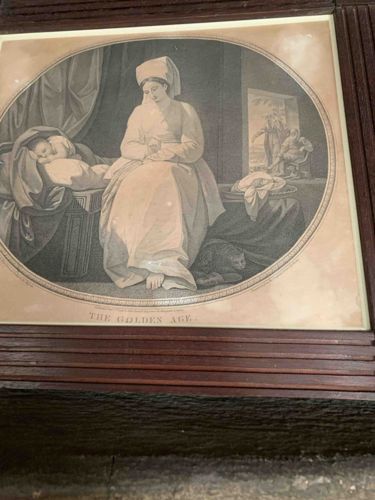
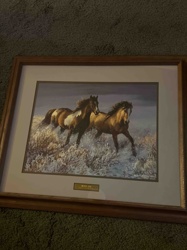
This item is a framed engraving titled "The Golden Age." The artwork depicts a domestic scene in what appears to be a classical style, rendered in grayscale, likely a print from a copperplate or steel engraving. The central figure is a woman, clad in a long, flowing gown and a head covering, seated beside a crib or bed where a baby is sleeping. Her hands appear to be engaged in some form of craft, possibly knitting or sewing. To her right, a window offers a view of an outdoor scene featuring figures, possibly classical deities or allegorical representations, suggesting a narrative beyond the immediate domestic setting. Below the window, another figure (perhaps a child or an animal like a cat) is dimly visible in shadow. The print itself is oval-shaped, set within a rectangular matte that is light-colored, possibly off-white or cream, which has yellowed with age, particularly noticeable in the upper right quadrant where a discoloration or stain is visible. The entire piece is housed in a wooden frame with a dark, reddish-brown finish. The frame features a simple, multi-layered profile with horizontal ridging on its inner face, adding a modest decorative element. There are visible signs of wear and age on the frame, including minor scratches and scuffs consistent with handling and time. The overall condition of the paper shows signs of aging, such as yellowing and potential foxing or discoloration, although the image clarity remains largely intact. The text 'THE GOLDEN AGE' is clearly printed at the bottom center, just beneath the oval, serving as the title of the piece. The craftsmanship of the engraving suggests a period when such prints were a common form of art reproduction, possibly 18th or 19th century.
AI Appraisal Report
I have examined the provided image of 'The Golden Age Engraving in Wooden Frame.' My assessment of its condition, based solely on visual inspection, indicates significant signs of age. The print itself exhibits yellowing, and there's a noticeable discoloration or stain on the upper right quadrant of the matte. The wooden frame shows wear, including scratches and scuffs, consistent with its likely age. Authenticity as a period engraving appears probable, given the style and visual cues, but definitive authentication is limited without physical examination.
From the image, the item appears to be an 18th or 19th-century engraving, a common form of art reproduction during that era. Market conditions for such unframed or framed engravings can vary widely. While the subject matter is appealing, depicting a classical domestic scene, the print does not appear to be by a historically significant or highly sought-after engraver. Comparables typically sell in the lower range unless they are by a known artist, are rare, or are in pristine condition. This piece, while charming, is not demonstrably rare, nor is its condition pristine.
Key factors impacting its value are the age-related condition issues of the print and matte, and the absence of a named artist. The overall condition places it more as a decorative period piece rather than a valuable art investment. For full authentication, I would need to physically examine the paper for watermarks, printing techniques, and specific signs of foxing that might indicate age and origin. Research into the publisher (if credit is present on the print) would also be crucial. Without these, and lacking provenance documentation, the authenticity of its exact age and attribution remains an informed visual estimation.