AI Appraisal Estimate

AI-generated estimates · not official valuations

From the user

What was submitted

Photo and notes provided by the user — not generated by AI

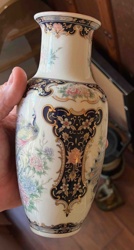
Submitted item photo
Submitted photo · June 6, 2026

User's notes

No additional notes provided.

AI analysis below

AI appraisal

AI analysis & estimate

AI-Generated · Verify before acting

Everything below is generated by AI for informational purposes only. AI can make mistakes — the AI may misidentify items or misattribute them (artist, maker, brand, designer, origin, era). This is not an official valuation and should not be used for insurance, sale, tax, estate, legal, or lending purposes — or any decision requiring a certified appraisal. It is not an authoritative claim about any person, brand, or rights holder — do not share or rely on it as a factual statement about a third party. Always consult qualified professionals before making financial decisions.

Read the full disclaimer

AI Identification

·Not independently authenticated·Verify before acting

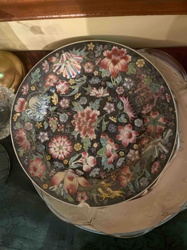
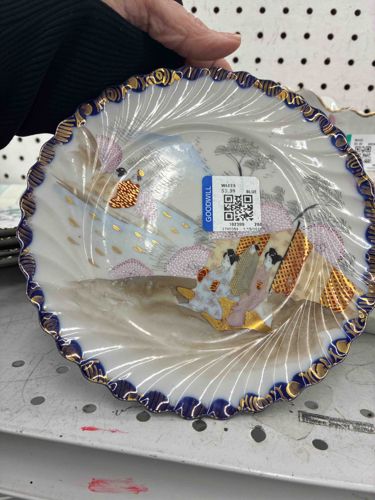
Japanese Satsuma Style Scalloped Porcelain Plate

Vintage Asian Ceramics

AI Estimated Value

·Not an official valuation·Verify before acting

$45.00 - $75.00

As of June 6, 2026

AI Item Analysis

·AI can make mistakes·Verify before acting
This item is a Japanese decorative porcelain plate featuring a distinct scalloped or 'pie crust' edge with a spiral fluted texture radiating from the center. The plate is constructed from fine white porcelain and decorated with a hand-painted or transfer-overlay central scene depicting figures in traditional Japanese attire, likely geishas, set against a landscape with cherry blossoms. The rim is heavily embellished with a deep cobalt blue 'flow blue' style border, overlaid with intricate gold-colored gilding in a repeating scrolling motif. The porcelain exhibits a glossy glaze, though a modern Goodwill price tag is affixed directly to the center. Notable features include the moriage-style raised gold accents on the robes and landscape, characteristic of Meiji-era influenced export ware (likely mid-20th century). Physically, the plate appears to be in fair condition with no visible cracks or large chips to the rim, though the heavy gilding may show minor shelf wear or thinning. The presence of the sticker suggests it is a vintage mass-produced trade item rather than an ancient artifact. Quality indicators include the precise scalloping and the contrast between the cobalt border and the delicate interior palette of pink, gold, and grey tones.
AI Appraisal Report

·AI can make mistakes·Verify before acting
This item is a mid-20th-century Japanese Satsuma-style porcelain cabinet plate, likely produced during the post-WWII 'Occupied Japan' era or slightly later for the export market. My examination of the scalloped 'pie crust' rim and the heavy cobalt blue border with gilt-stencil scrolling indicates it is a mass-produced decorative item rather than a 19th-century Meiji-era piece. The 'moriage' (raised enamel) application on the central figures lacks the extreme delicacy found in high-end studio ceramics, pointing toward a commercial manufacturing origin. Condition appears fair. The glaze remains glossy, but the presence of a modernization sticker suggests potential residue or surface scratches beneath the adhesive. While no structural chips are visible, I observe minor thinning in the gilding at the crown of the fluted edges, consistent with shelf wear. Market demand for mid-century Japanese export ware remains stable but saturated. Comparable pieces from manufacturers like Noritake or generic 'E-N' marked factories frequently sell in the $40–$80 range at regional auctions. The lack of rarity and the 'trade item' nature of the transfer-print base limit its appreciation potential. Authentication via digital imagery is limited; a physical inspection is required to check for a maker's mark on the reverse, which could marginally adjust the value. To confirm a higher valuation, I would need to investigate the back for 'Hand Painted' signatures versus total transfer applications and look for the specific kiln mark under a jeweler's loupe. Scientific testing is not recommended as the cost would exceed the item's fair market value.

Get your items appraised

Instant estimates of your treasures with AI-powered appraisals

Browse More Appraisals