AI estimate as of November 4, 2025 · verify with a professional before acting
AI-Generated · Verify before acting
Everything on this page is generated by AI for informational purposes only. AI can make mistakes — the AI may misidentify items or misattribute them (artist, maker, brand, designer, origin, era). This is not an official valuation and should not be used for insurance, sale, tax, estate, legal, or lending purposes — or any decision requiring a certified appraisal. It is not an authoritative claim about any person, brand, or rights holder — do not share or rely on it as a factual statement about a third party. Always consult qualified professionals before making financial decisions.
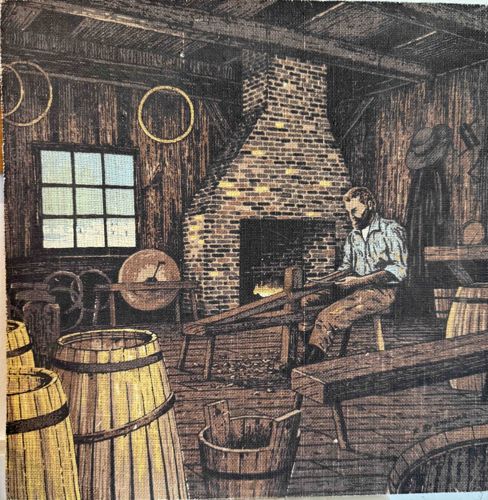
This item is a fabric panel depicting a historical scene within a coopersmith's workshop. The image is rendered in a folk art or illustrative style with a limited but effective color palette, primarily featuring earthy tones of brown, tan, and rust for the wooden structures and brick fireplace, accented by blues and whites for the window and the coopersmith's shirt. The fabric itself appears to be a woven material, possibly a linen or cotton blend, given the visible texture and slight fraying along the edges in some areas, suggesting it might have been cut from a larger piece of textile. The scene shows a bearded man, presumably the coopersmith, seated on a stool, working on a piece of wood near a glowing brick fireplace which serves as a central focal point. Various tools and barrels are scattered throughout the workshop, including several large wooden barrels in the foreground and a smaller wooden bucket. A grindstone and another tool with a large wheel are visible near a multi-paned window, which lets in a light blue sky. Two wooden hoops hang on the plank wall, likely for barrel construction. The overall impression is one of rustic craftsmanship and historical accuracy, portraying a skilled trade. There are no clear visible condition issues beyond what appears to be simply edges cut from a larger roll, and no discernible maker's marks, signatures, or stamps are present. The style suggests a mid-20th century interpretation of an 18th or 19th-century scene.
AI Appraisal Report
I have examined the image of the Coopersmith's Workshop Fabric Panel. Visually, the panel appears to be in very good condition, presenting a clean and well-preserved depiction of the coopersmith scene. The slightly frayed edges suggest it was cut from a larger piece of textile, which is consistent with decorative fabric panels. Authenticity, based solely on visual inspection, points to it being a decorative fabric panel, likely intended for framing, quilting, or other craft applications. The folk art style and color palette suggest a mid-20th century production, interpreting an 18th or 19th-century historical scene. There are no obvious flaws or significant wear that would detract from its aesthetic appeal. The absence of maker's marks or signatures is common for this type of textile art. The fabric texture, seemingly a cotton or linen blend, is appropriate for the period and style inferred.
In terms of market conditions, decorative fabric panels, particularly those with a historical or craft theme, generally fall into the affordable range for collectors and crafters. Comparables in the market often include similar printed historical or Americana-themed textile art found in antique shops, online marketplaces, or textile shows. Demand for such items is steady but not high, appealing to niche collectors interested in historical trades, decorative arts, or textile crafts. It is not considered rare. Factors that significantly impact its value include its good condition and endearing subject matter. However, the lack of known provenance, artist, or specific manufacturer limits its potential for higher valuation.
It is crucial to note the limitations of authenticity verification from images alone. A physical examination would allow me to assess the exact fabric composition, printing technique (e.g., screen print), and confirm the absence of any hidden marks or repairs. Further, scientific testing could definitively date the fabric and pigments, and provenance documentation, if available, would significantly enhance its authenticity and potential value by linking it to a specific artist or textile mill.